


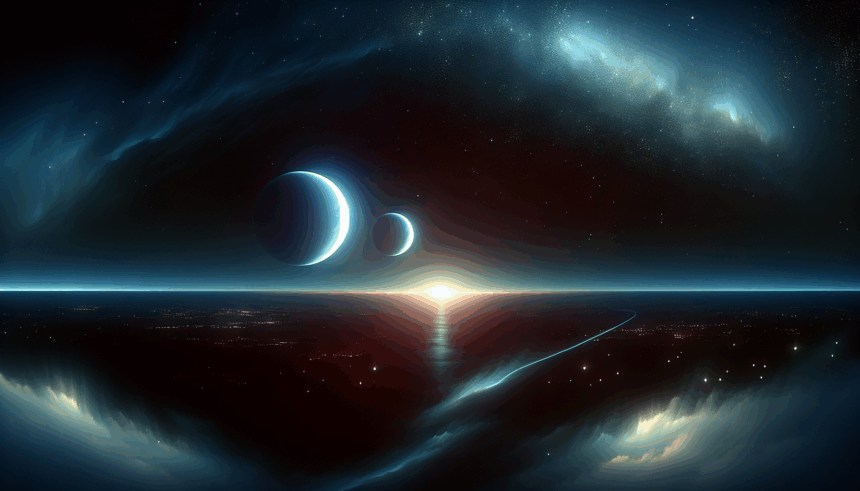
Venus and Jupiter will meet in a spectacular conjunction in the early morning hours of August 12, 2025. To view the conjunction, you will need to either stay out late or get up early. Venus and Jupiter will rise together around 3 a.m. local time and set around 6 a.m. However, these times may vary slightly depending on your exact location.
The conjunction will be visible in the east, near the constellation Gemini. It will ascend to about 20 degrees above the horizon before sunrise. Because the planets will be relatively low on the horizon, it’s best to observe them from a flat area devoid of trees, buildings, or other obstructions to the east.
Both Venus and Jupiter are exceptionally bright. They can be easily spotted with the naked eye. Venus is the second-brightest object in the night sky after the moon, followed by Jupiter.
Seeing these planets through a decent backyard telescope or binoculars will offer an enhanced experience. It will allow you to observe Jupiter’s cloud bands and its famed Great Red Spot. This enormous storm on Jupiter completes a rotation roughly every 10 hours.
It is most visible when it crosses the planet’s meridian.
Venus and Jupiter’s August meeting
Venus also offers intriguing views through a telescope.
Like the moon, it undergoes phases—new, crescent, quarter, gibbous, and full. These phases are based on its position relative to Earth and the Sun. They are only visible using skywatching equipment.
The moon will be a waning gibbous, roughly 90% to 95% illuminated, on the night of the conjunction. It will rise around 9:30 p.m. and set near 10 a.m. local time. Fortunately, Jupiter and Venus are bright enough to stand out despite the moon’s glow.
To minimize the moon’s interference, try viewing the planets from a location where the moon is obstructed by trees or buildings. If you miss the conjunction on August 12, don’t worry. Venus and Jupiter will remain close together for several nights.
However, they will gradually drift apart as the month continues. For astronomy enthusiasts and casual skywatchers alike, this conjunction is a must-see event. It offers a unique opportunity to observe the two brightest planets in our solar system in close proximity.