


Arieso, a wireless network management company, reported this week that a very small number of users consume the bulk of mobile wireless data. Specifically, Aireso found that the top 1% of users account for half of all data. For some reason, the tech world reacted with surprise.
Despite an abundance of data that threatens to drown us, most of us rely on preconceptions rather than hard numbers to form our notion of how the world works. This leads to bad business decisions and, in the public sphere, terrible policy.

One of the big mistakes we keep making is the assumption that the distribution of most things follows the familiar bell-shaped curve, what statisticians call a normal or Gaussian distribution. Statisiticians love the normal distribution because it has wonderfully convenient mathematical properties. And while is does describe the distribution of a number of natural phenomena–the heights of people, for example–the classic bell curve is actually fairly rare in the real world.
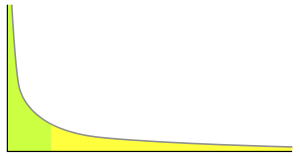
What’s much more common is what’s known informally as the 80/20 distribution, from the ancient observation that 20% of the people drink 80% of the beer. This is more properly called a power law (or Pareto) distribution. The key to a power law distribution is that the bulk of what is being measured is found at the far left of the distribution, with a long tail off to the right.
We should realize that everything from wealth to wireless data consumption follows a power law distribution and stop being surprised by the fact. In the case of wireless data, this distribution actually has important business and public policy implications. If a very small number of consumers are responsible for a very large share of data usage, it becomes fairly simple to manage any shortages through pricing policies that affect the tiny minority of mega-users without affecting most of the public.
But neither government regulators nor wireless carriers are acting as though they understand this. We have vastly more data available to support decisions than ever in the past. But it does us no good unless we pay attention.