


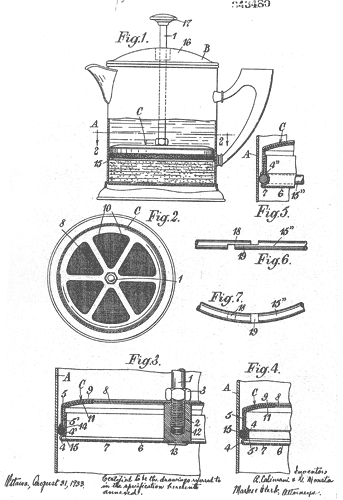
In 1929, an Italian named Attillo Calimani received a patent for a French press coffee maker. The French press is an extremely simple design: a glass beaker, a metal mesh filter attached to a push rod, and a gasket to form a seal between the filter and the glass. Calimani’s coffeepot looks remarkably like the Bodum press I use every morning. Its design follows its function so elegantly that it doesn’t seem like something that needed inventing. Yet it wasn’t until coffee had been around for hundreds of years that the imagination and manufacturing technology combined to make the French press a practical device.
This, in fact, is a characteristic of the very best in design and invention. Once you see it, it seems inevitable, as though it should always have existed. But that simplicity often takes a a tremendous amount of effort to achieve.
And that is what is wrong with the arguments of Samsung and its supporters that Apple’s iPhone patents were invalid because the key design features were obvious. U.S. patent law imposes a threefold test for patentability: An invention must be novel, useful, and non-obvious. The much-maligned U.S. Patent & Trademark Office found that Apple met that test for various features of the iPhone and the jury, the the extent it could consider the validity of the patents, agreed.
Now it’s true that there is nothing completely new under the sun. According to the history of the French press on the Galla Coffee web site, two French inventors came up with the French press idea nearly a century before Calimani. But their design lacked the gasket around the filter, leaving a lot of coffee grounds behind when the plunger was pushed, In other words, they had the right idea but it it didn’t quite work. Success requires that you both have an idea and find a way to make it practical.
It’s useful to reflect on just what Apple invented with the iPhone that did not exist in 2007. Apple did not invent the multitouch capacitive display, but was the first to use it in a phone. (Microsoft, by contrast released a version of its Windows Mobile software in late 2009 with no support for multitouch displays.) Apple designers realized that a multitouch screen made both an on-screen keyboard and the elimination of virtually all physical buttons practical. (Large-screen Symbian phones existed before the iPhone, but they lacked multitouch and designers felt compelled to add physical keyboards or at least dialpads.) Despite the handicap of slow network connections–the original iPhone did not offer 3G wireless–Apple realized there was real value in web browsing on a phone and even originally thought that the web was a viable alternative to native apps.
It’s interesting that the most successful competitor to the iPhone is the one that has stuck most closely to the Apple formula, Android. Research in Motion, which thrived for a long time partly because of another obvious, non-obvious invention–a practical miniature keyboard–lost its way by ignoring the Apple assault until too late. Palm offered a real alternative with webOS, but lacked the financial resources to give it a fair chance (I’m not going to go into the Hewlett-Packard fiasco again.) And Microsoft has had a very tough time gaining traction for its distinctive approach, but it’s way to early too count them out.
There are legitimate fears that the decision in Apple v. Samsung will stifle innovation, but I am optimistic that the result will be the opposite: Forced to compete rather than copy, Apple’s competitors will find their way to true competition.
And as for the claim that Apple really didn’t come up with anything strikingly original in the iPhone design, that anyone could have done it, I’ll paraphrase what Aaron Sorkin’s “Mark Zuckerberg” famously said in The Social Network: If you guys were the inventors of the iPhone, you would have invented the iPhone.
UPDATED: At TechCrunch, Leonid Kravets, an actual patent lawyer, weighs in on the issue of obviousness and the Apple-Samsung verdict. The conclusions are similar, but I bet he had less fun writing it.