


There’s a profusion of Android phones on the market and they all have an awful lot in common. They’re almost all rectangular slabs with displays ranging from 3 1/2 to nearly 5 inches and differ mainly in the color of the case and how ronded its corners are. The biggest difference available: Some models feature slide-out keyboards (and thicker bodies) while some offer just an on-screen keyboard. You’d never know from this lot that Android offers manufacturers almost total flexibility in hardware design.
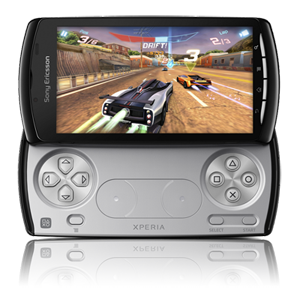 Then there’s the Sony Ericsson Experia Play. ($200 in the U.S. with two-year Verizon Wireless contract.) I don’t know whether the Play can revive the flagging fortunes of Sony Ericsson, but I’m glad to see themselves try something really different.
At first glance, the Play looks like every slider keyboard Android: Shiny black, rounded plastic case, 4″ 854×480 pixel display, 6.2 oz. (175 g), a bit over half an inch (16 mm) thick. But when you slide the bottom out, instead of a keyboard you see a game controller pad modeled on those used with the Sony PlayStation 3. In place of keys, you get a full set of gaming controls: the familiar directional and symbol pads, physical select, start, and menu buttons, and two circular areas that are designed to simulate analog joysticks. Games can use all these controls, plus the touchscreen and motion sensitivity.
I don’t play game a lot and I really can’t say how a hard-core game would feel about the Play, but I found it a lot of fun. The screen is crisp, though I had to turn up the brightness manually for satisfactory play. The Qualcomm Snapdragon processor provides more thjan adequate performance.
When not playing games, the Play becomes a standard Android phone with all the expected features. But it’s not likely to be anyone’s choice unless the gaming is important–then it’s just a thick handset without a physical keyboard.
I’d like to see more manufacturers experiment more freely with what Android has to offer. It’s the only viable phone operating system that offers this sort of freedom. Apple’s iOS, Research In Motion’s BlackBerry and (so far) Hewlett-Packard’s webOS are not available to other OEMs. Microsoft, burned by the fragmentation of design of Windows Mobile phones, is keeping a very tight rein on Windows Phone 7 designs.
Android creates the possibility for considerable variety combined with support for core Android features and apps. It’s a tricky balancing act, but it would be good to see more specialized handsets hit the market.