


I cringe whenever I see a reference to the “law of large numbers,” knowing that it is almost certain to be incorrect. Blogger Dr. Drang has already done an excellent takedown of the New York Times‘ James B. Stewart for a silly column in which he warned that Apple may be “running up against the law of large numbers.”
The reason I go overboard on this subject is that the law of large numbers is a very important concept that we cannot afford to lose. It has nothing whatever to do with growth. What it actually says is that as a large number of samples of a random variable are taken from a population, the mean of the samples approaches the expected value of the population. In other (and simplified) terms, the larger your sample the better your estimate of the actual value. This theorem and its more sophisticated cousin, the central limit theorem, are the basis of all sampling, polling, and inferential statistics.
So what do we call the principle that the growth rate of things tends to slow as they get larger? The idea is kind of obvious, which may be why it doesn’t have a name. But then, the law of large numbers, the real one, is somewhat obvious, too. All the best theorems are.
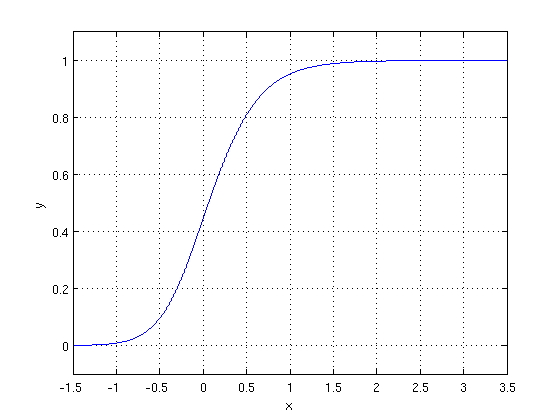
I propose we call it the logistic principle. The name comes form the logistic function, which models how many things grow in the real world. Growth starts out slow, then accelerates rapidly. But at some point, the growth hits some sort of constraint, usually because a resource begins to grow scarce. This causes a sharp slowdown in growth. (see graph above.) For populations, the constraint is usually food. In the case of Apple, the constraint might be that everyone who wants and can afford an iPad or iPhone already has one (and I think Apple is probably still a long way from the point of inflection.)
At least the law of large numbers exists, even if it doesn’t mean what most people think it does. The law of averages, which is also used to predict the end of a run of success like Apple’s, is completely fanciful and, in fact, is known to statisticians as the gambler’s fallacy.