


Americans used a record 159.3 trillion megabytes of mobile data in 2025, up 20 percent from the year before, according to CTIA’s annual survey as reported by Broadband Breakfast. The industry group expects demand to quadruple by 2032, driven partly by AI. American Tower CEO Steven Vondran has put the engineering consequence plainly: the growth is expected to require a doubling of wireless network capacity between now and 2030, he said on the company’s fourth-quarter call, RCR Wireless reported.
Most of the attention in wireless policy goes to spectrum auctions, and for good reason. But I think the next five years of U.S. network building will be decided at least as much by the less glamorous work of adding sites, antennas and radios where people actually use their phones. The country has largely finished the coverage phase of 5G. The capacity phase is a different kind of buildout, and it is already underway.
From coverage to capacity
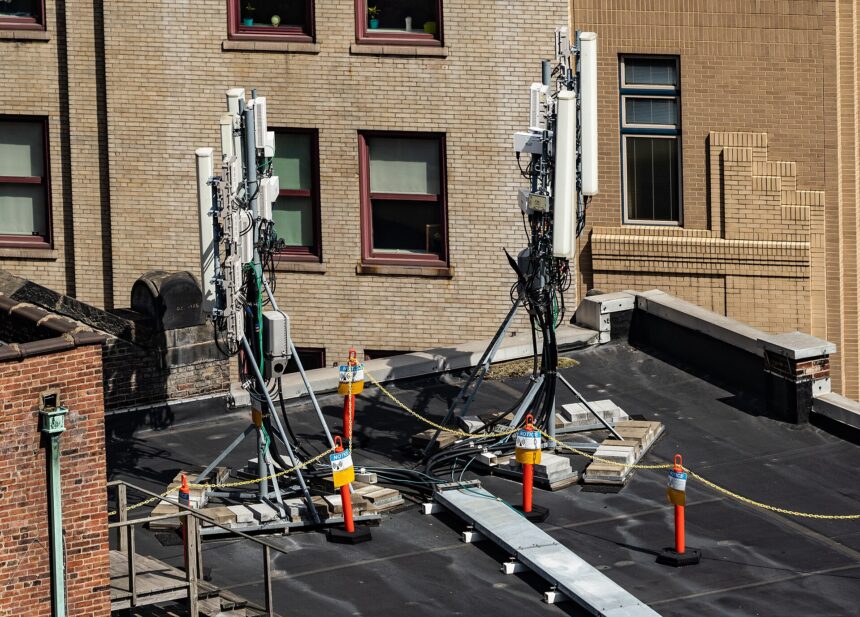
On the same call, Vondran said U.S. carriers are in the middle stages of the 5G cycle: they have broadly completed their initial coverage-oriented work and are shifting toward capacity. In practice, that means fewer upgrades to equipment already on a tower and more new equipment placed on additional towers and rooftops.
American Tower is already seeing that shift in its order book. Speaking at a Goldman Sachs conference in September, Vondran said new business was moving “a little bit less on the amendment side, more on the colocation side,” according to RCR Wireless. Amendments add gear to a carrier’s existing sites; colocations put a carrier on a site it wasn’t using before. He said the rest of the needed capacity will come from spectrum and site densification.
The investment base is there. Carriers spent $30 billion expanding and upgrading their networks in 2025, on par with the previous two years, according to the same CTIA survey.
Why spectrum alone can’t carry the load
New spectrum is coming. The FCC’s upcoming Upper C-band auction is part of a larger pipeline; Vondran said 800 MHz of spectrum has been earmarked to come to market over several years. But spectrum on paper isn’t capacity in the air. MoffettNathanson analyst Nick Del Deo noted that Upper C-band spectrum “won’t be available for deployments for several years” after the auction, Broadband Breakfast reported.
That gap is where densification does its work. Adding sites reuses the spectrum carriers already hold more intensively, because each cell serves a smaller area and fewer users. Crown Castle’s chief commercial officer, Kris Hinson, said in September that he expects macro towers to remain part of the solution while small cells also expand, RCR Wireless reported. That matches how capacity has always been added in busy markets: big towers for the base layer, smaller cells filling in where demand concentrates.
CTIA, the industry’s trade group, has been making the spectrum side of the case publicly:
Demand is steadily rising while the U.S. wireless industry faces a deficit of licensed mid-band spectrum, with 23% of peak demand going unmet by 2027. To maintain U.S. global leadership, we need more mid-band spectrum for full-power, licensed commercial use. More:… pic.twitter.com/dgWzZrqx0j
— CTIA (@CTIA) April 7, 2025
The uplink question
The newer wrinkle is AI. Today’s networks are built for downloads; phones pull far more data than they send. Vondran said AI traffic is still a small but rapidly growing share of mobile use, and that the uplink AI applications need is more than networks were designed for, which could eventually mean re-architecting parts of the network. Hinson said some AI use cases could need uplink capacity three times higher than today’s levels.
My take is that uplink is where densification pays off most. A phone’s transmit power is limited, so the shorter the distance to the nearest cell, the more data it can send. If AI assistants that stream live camera and audio become common, the networks with more sites closer to users will handle them best.
The case for a slower curve
There is a fair argument that the buildout will be more gradual than the capacity forecasts imply. Data growth is slowing: the 20 percent increase in 2025 followed gains of 32 percent in 2024 and 35 percent in 2023, per the CTIA figures. Hinson said in September that AI is “not having an impact today” on Crown Castle’s numbers. And Del Deo has written that 6G is years away, which means the next big equipment cycle isn’t imminent either.
Those are real points. Slower percentage growth on a much larger base still adds a lot of traffic, though, and 20 percent annual growth compounds to roughly double in four years. Networks have to be built ahead of demand, not after it shows up in congestion.
What to watch
What I’ll be watching over the next year is the mix of tower activity: whether colocations keep gaining on amendments, and how much new small cell and rooftop work shows up in dense metros. Those are the clearest signs that capacity building has taken over from coverage building. The spectrum auctions will set the long-term ceiling. Densification is how the industry keeps ahead of demand until that spectrum is on the air.
Roger Sartain is SVP and General Manager of Wireless & OSP at Telamon.
Related reading: The FCC’s Upper C-band plan creates a 440 MHz super band · AT&T, T-Mobile and Verizon now share one satellite venture · Fiber now reaches 60% of U.S. homes