


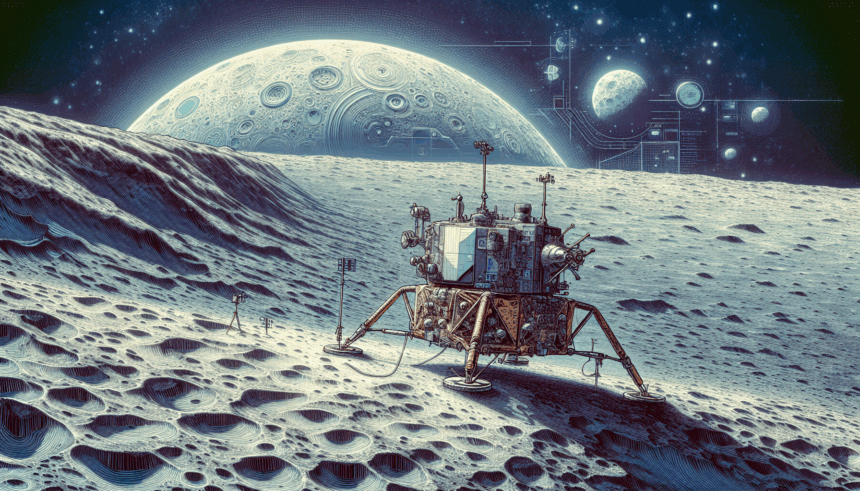
China’s Chang’e-6 mission has returned the first-ever rock samples from the far side of the moon. Scientists have analyzed these samples and made a surprising discovery. The moon’s far side mantle is significantly cooler than the near side mantle.
The samples, which are about 2.8 billion years old, were collected from a crater on the moon’s far side. Researchers used electron probes and ion probe techniques to study the samples’ composition. They found that the far side mantle may have crystallized at around 2,000 °F (1,100 °C).
This is about 212°F (100 °C) cooler than similarly aged rocks from the moon’s near side. “The near side and far side of the moon are very different at the surface and potentially in the interior,” said Dr. Yang Li, a professor at University College London who co-authored the study.
“It is one of the great mysteries of the Moon. We call it the two-faced Moon.”
The moon is known for its asymmetry. The far side has more rugged highlands, fewer dark basaltic plains, and a thicker crust than the near side.
Cooler lunar far side mantle explored
Scientists think this could be because heat-producing elements, such as uranium, thorium, and potassium, are unevenly distributed. If these elements are more concentrated on the near side, that hemisphere could have stayed warmer while the far side cooled faster.
There are several theories for how this uneven distribution might have happened. One idea is that a massive asteroid or planetary impact early in the moon’s history caused it. Another theory suggests that the moon merged with a smaller companion moon.
Earth’s gravitational pull could also have influenced internal heat flow, making the near side slightly hotter. These new findings challenge many existing models of lunar formation and evolution. Most models assume that the moon’s interior is relatively uniform.
As more samples from the far side become available, researchers will be able to test whether this temperature difference is localized or a global phenomenon. “These findings take us a step closer to understanding the two faces of the moon,” said Xuelin Zhu, a co-author and PhD student at Peking University. “They show us that the differences between the near and far side are not only at the surface but go deep into the interior.”
The Chang’e-6 mission’s success in returning far side samples marks an important milestone in lunar exploration.
It provides valuable data that will help refine models of the moon’s geological and thermal history. As China’s ambitious lunar exploration program continues, we can expect to gain even more insights into the mysteries of our closest celestial neighbor.