


Will homemade 3D objects be the next intellectual property battleground. Perhaps, bit this time the fight will be very different because the makers, not the owners, have the legal high hand.
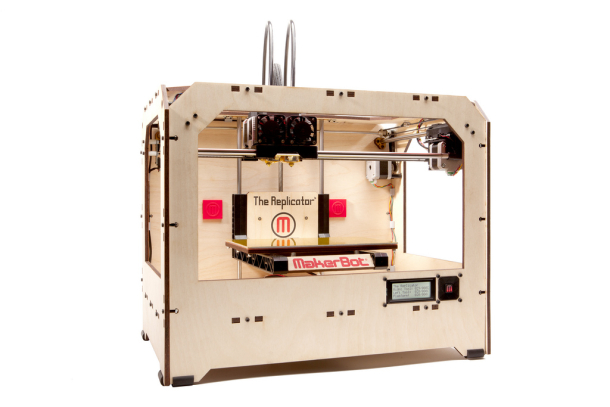
3D is one of most exciting technologies to emerge in a long time. Machines using inkjet-like technology lay down precise layers of material. If you can create a file describing an object, and programs such as Autocad and Mathematica can do this automatically, you can print it.
High-end printers can create objects in aluminum, stainless steel, and ceramic. Simpler units, such as the $2,000 MakerBot Industries Replicator can print objects in two colors of ABS plastic.
The Pirate Bay blog waxed rhapsodic about the prospect:
We believe that the next step in copying will be made from digital form into physical form. It will be physical objects. Or as we decided to call them: Physibles. Data objects that are able (and feasible) to become physical. We believe that things like three-dimensional printers, scanners and such are just the first step. We believe that in the nearby future you will print your spare parts for your vehicles. You will download your sneakers within 20 years.
But it turns out that replicating objects is far from piratical for the simple reason that no existing form of intellectual property protection covers most physical objects. The only 3D objects off any sort on the Copyright Office’s list of protected works are sculptures and architecture. You can trademark something like the Nike swoosh and the concept of trade dress provides some protection to designs, but the fashion industry learned decades ago that neither copyright nor trademark could stop design knockoffs, such as a mass market version of a couturier dress. Patents could provide limited protection but it is very hard to use a patent to protect a part.
In the past, this gap in IP coverage wasn’t much of an issue. Skilled machining and toolmaking were too expensive for knockoff parts to be economic. Only where there was a opted rial for large sales, such as automotive crash parts that mimicked original body panels, did copying parts make sense.
The coming of 3D printers and other equipment, such as inexpensive computer numerically controlled (CNC) machine tools has drastically changed the landscape. I think it is unlikely that printed objects will ever be cheaper than standard mass production, but scanning and printing replacement parts, profitable items for many manufacturers, will become common.
I’m sure there will be attempts to restrict scanning and copying of physical objects. (Efforts to win copyright protection for objects such as laser printer toner cartridges by embedding chips with ostensibly copyrightable code have failed miserably in the courts.)But one important lesson of the (so far) successful fight against the Stop Online Piracy Act is that it is a lot easier to stop a law than to pass one. This time the makers sand a good chance of winning.