


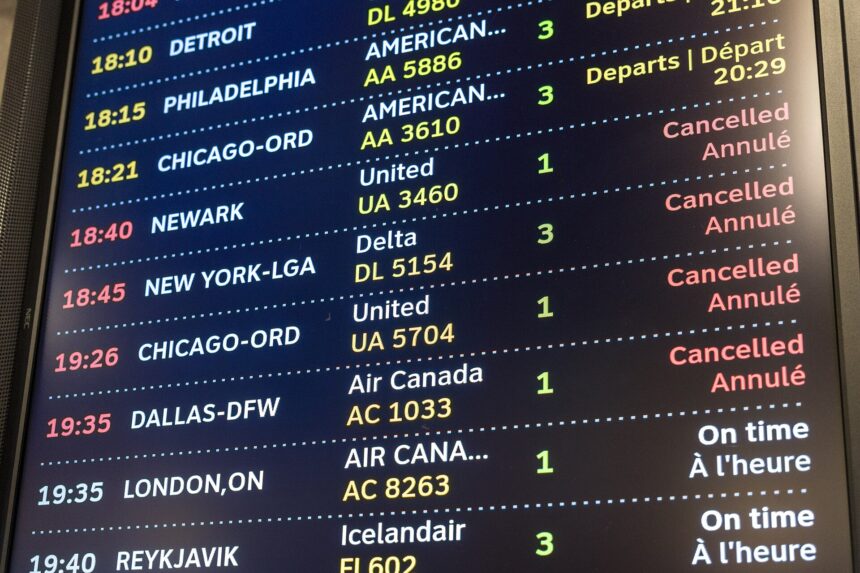
At 3:54 p.m. Eastern on Friday, November 13, the Federal Aviation Administration ordered every departing flight in the United States to stay on the ground. The stop lasted four hours and 21 minutes, ClearanceJobs reported, and it was only the third nationwide ground stop in U.S. history. The FAA counted about 12,462 flight cancellations, including 9,082 by major airlines, though it said not every one was directly caused by the ground stop, according to Newsweek.
The cause, according to officials, was not an attack and not the aging equipment everyone has been warning about. It was new equipment, installed as part of the effort to replace that aging equipment. Transportation Secretary Sean Duffy described what happened on CBS:
Transportation Secretary Sean Duffy blamed old air traffic control systems for the telecommunication issues behind the FAA nationwide ground stop on Friday.
"Our switches, our routers actually got overloaded with data," he said. "They started to give us inconsistency in the data… pic.twitter.com/5iX8mqL7RP
— CBS News (@CBSNews) November 14, 2026
I think that detail is the real story. America’s air traffic system is in the middle of a huge rebuild, and Friday showed that the rebuild itself is now one of the biggest risks to the system.
What went wrong
The FAA’s telecom contractor, L3Harris, was working at a remote facility in El Dorado, Arkansas, replacing an aging copper communications connection with fiber, Newsweek reported. A router installed during that work began flooding other routers with traffic. The FAA’s acting chief technology officer, Rebecca Guy, said two sites were pinging the network at a very high rate, about 1,000 connections every four to five seconds, according to ClearanceJobs. The instability reached 17 of the FAA’s 22 en route centers and disrupted voice and radar.
Investigators are also looking at a similar issue in Amarillo, Texas, where work had been done weeks earlier, and the FAA disabled the broadcasting feature on 69 routers across the airspace system as a precaution, Newsweek reported. FAA Administrator Bryan Bedford said officials found no evidence of malicious activity. The FAA and L3Harris are investigating with help from the FBI, and L3Harris did not respond to Newsweek’s request for comment. Duffy has said the possible causes include user error, installer error or faulty routers, and no public root-cause report has been released.
The upgrade nobody can skip
The copper-to-fiber project is the backbone of the FAA’s modernization. As of May 2026, the FAA reported replacing 2,560 of 5,170 old and frail copper wires, according to a September Government Accountability Office report. Duffy said on Sunday that about 70 percent of the FAA’s copper connections have now been converted, Newsweek reported. Congress appropriated $12.5 billion for the effort in July 2025, and the first phase is supposed to be finished by December 2028, the GAO said.
The GAO also warned about how the work was being managed. It found the FAA had not developed a comprehensive lifecycle cost estimate, and had 11,389 individual project schedules that were not integrated into a master schedule. DOT partially agreed with the GAO’s recommendations.
My take: thousands of separate cutovers on a live network that cannot go down is exactly the kind of job where a master schedule and a disciplined change process matter most. Friday was what a single bad cutover looks like at national scale. Duffy appears to agree on that point; he said the department will have to reevaluate when this work is done.
The case for moving fast anyway
The strongest argument for pressing ahead is that the old network is the bigger danger. Bedford said the system “will continue to break until we replace it,” according to ClearanceJobs, and the GAO report recounts years of failures on the old equipment, including the 2023 outage that caused the first nationwide ground stop since September 11, 2001, and telecom failures at Newark in 2025. Slowing down the replacement would mean living longer with the equipment that keeps failing.
There is also a fair point about scale. With thousands of connections already converted, one or two problem sites is a small failure rate. The trouble is that in air traffic control, a small failure rate can still stop every flight in the country.
Both things can be true. I’d argue the lesson is not to slow the upgrade but to change how each cutover is done: test new equipment in isolation, limit how far any single site can spread a problem, and schedule risky work for times when a failure would ground fewer flights.
What to watch
The key document is the root-cause report: whether it points to the router, the configuration, or the installation process will decide who is accountable and what changes. Also watch whether the FAA changes when and how it schedules cutovers, and whether Congress acts on Duffy’s request for more modernization money. For travelers, the uncomfortable reality is that the fix for the system’s fragility will run through 2028, and the work itself carries risk until it is done.
Related reading: Censys Found About 815 Exposed Deployments of ARTEX. · PHP2Shell Hit the Software Behind 70% of Websites.