


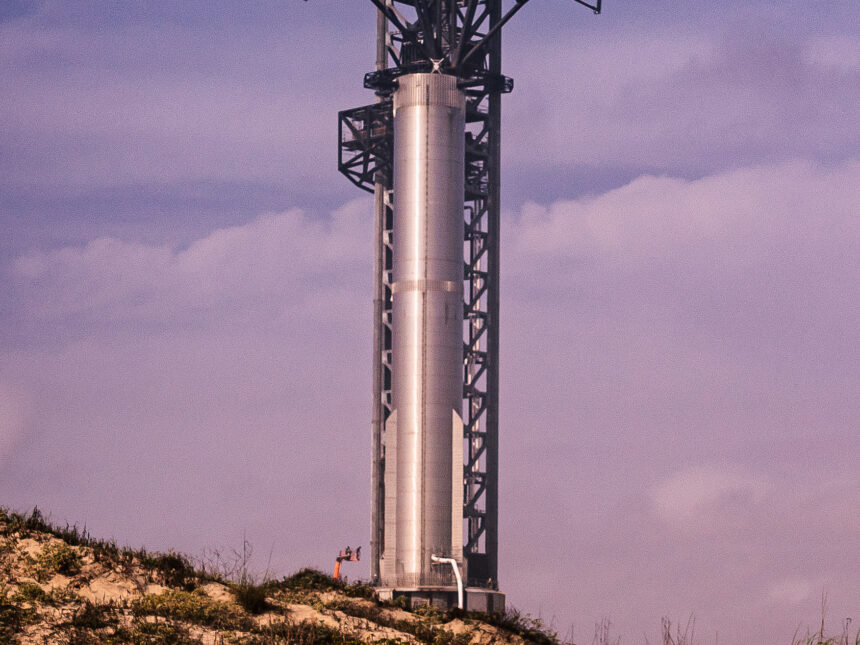
On September 28, SpaceX’s Starship carried 26 of the company’s new Starlink V3 satellites into orbit and released them, its first flight carrying operational satellites to orbit. Reuters, in a report carried by ThePrint, described it as Starship’s orbital debut, achieved despite one engine shutting down during ascent and a mission that ended earlier than planned. Elon Musk said all 26 satellites were deployed and operating normally.
SpaceX posted as the satellites began deploying:
Starship has begun deploying its payload of 26 @Starlink V3 satellites. This deployment sequence will take ~30 minutes pic.twitter.com/ycIdAx5Lbe
— SpaceX (@SpaceX) September 28, 2026
By the close that day, SpaceX stock fell about 2 percent. That reaction makes sense once you see what investors were actually watching. This was not mainly a space milestone. It was the first real test of the business plan SpaceX sold to the public markets in June.
The satellites only fit on one rocket
Starlink V3 is a different machine from the satellites SpaceX has been launching for years. Each one is designed for about 1 terabit per second of downlink capacity, roughly ten times a current V2 satellite, according to specifications summarized by Converge Digest. They are also much larger, and that is the catch: SpaceX designed them around Starship, not the Falcon 9 rockets that launched the existing constellation. SpaceX estimates a full Starship load of about 60 V3 satellites adds more than 20 times the network capacity of a Falcon 9 launch.
In other words, the next generation of Starlink does not exist at scale unless Starship flies, often.
Why that is the whole IPO
SpaceX’s prospectus made the stakes plain. Starlink brought in about $11.4 billion in 2025, 61 percent of the company’s revenue, and it was the only one of SpaceX’s three businesses to turn an operating profit, according to SatNews’ analysis of the filing. The launch business lost $657 million, with about $3 billion spent on Starship development. The AI business, built around xAI, lost $6.4 billion.
Put those numbers together and the structure of the company becomes clear. Starlink is the profit engine, and its growth plan runs through Starship. That is why the prospectus lists Starship as its first risk factor, warning that if Starship cannot reach the needed launch cadence and reusability, the deployment of V3 satellites would be materially and adversely affected. The rocket is not a side project the satellites happen to use. It is the bottleneck on the only part of SpaceX that makes money.
What one flight does and doesn’t prove
The September flight proved the most important thing: Starship can carry V3 satellites to orbit and release them working. That was not guaranteed. This was Starship’s 14th test flight since 2023, and the first to reach orbit, according to Reuters.
What it did not prove is the part the business depends on. One flight carried 26 satellites. The plan calls for about 60 per flight, flown repeatedly, on reused hardware. Musk has said Starship is two to three years away from hourly flights. Taken at face value, that is the kind of cadence that would make V3 economics work. Taken against the record, it is a very long way from 14 flights in three years, the most recent of which lost an engine on the way up.
That gap is what the stock was pricing. The likeliest reading is that investors had already assumed Starship would reach orbit. A flight that did exactly that, with an engine problem along the way, confirmed the assumption without changing the timeline.
The case that the market is underrating this
There is a strong bull argument, and it rests on SpaceX’s own history. Falcon 9 also started slowly and was doubted for years before becoming the company’s workhorse. If Starship follows a similar curve, each V3 launch adds network capacity on a scale no competitor can match, and Starlink’s profits could grow faster than the satellites’ cost. On that view, a 2 percent dip after the first working flight is the market being too cautious.
The skeptical view is that Starship’s reliability, not its first success, is what matters, and that Starlink’s profits are being asked to fund both Starship development and multibillion-dollar AI losses at the same time. Both views agree on one thing: the next dozen flights matter more than this one.
What to watch
The signals worth tracking are simple. How long until the next V3 flight. Whether the next one carries closer to 60 satellites than 26. Whether SpaceX recovers and reflies the ship, not just the booster. And whether Starlink’s next quarterly report shows capacity, and revenue, growing faster than it did on Falcon 9 alone. Those numbers will tell investors whether September 28 was the start of a new network or a single very good day.
Related reading: A Startup Wants 456 Nuclear Reactors in Utah. · Is AI a Bubble or a Revolution? The Honest Answer Is Both.