


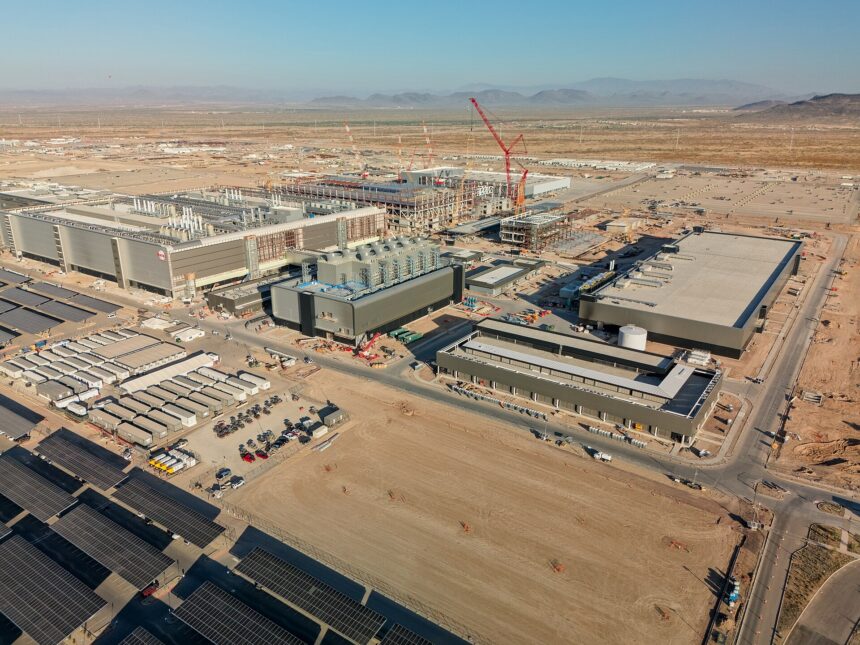
In July, TSMC said it would spend another $100 billion in Arizona, bringing its total commitment there to $265 billion across 12 facilities, including four more fabs for its 2-nanometer process or better, according to the City of Phoenix. Arizona’s business community celebrated:
Another blockbuster investment for Arizona 🔥
TSMC has announced another $100 billion for its Phoenix operations, bringing its total U.S. commitment to a historic $265 BILLION.
More leading-edge fabs, more advanced packaging facilities, more high-wage jobs. Another huge vote of… https://t.co/LObCIeF7GF
— Arizona Chamber (@AZChamber) July 16, 2026
Buried in the city’s announcement is the number that explains what Taiwan is doing. When the buildout is complete, about 30 percent of TSMC’s 2-nanometer and more advanced capacity will be in Arizona. The other 70 percent stays in Taiwan. And in late September, Taiwan’s government made clear which part it considers non-negotiable.
Factories can move. The lab stays.
In a policy report to Taiwan’s legislature at the end of September, Premier Cho Jung-tai said the island’s chip industry now spans manufacturing bases on three continents. Taiwan supports TSMC’s U.S. expansion, DigiTimes reported, but insists that core research and development stays home.
Taiwan is putting money behind that line. Earlier in September, the government laid out plans to invest NT$300 billion, about $9.5 billion, through 2033 in next-generation chip design and advanced semiconductor processes, Focus Taiwan reported. The program includes a research line for processes below 1 nanometer. Cho said Taiwan still needs to keep investing in research and talent to consolidate its advantages.
The production schedule follows the same logic. TSMC began 2-nanometer production in Taiwan in late 2025, Focus Taiwan noted. In Arizona, the first fab has been making 4-nanometer chips since late 2024, and a second fab for 3-nanometer chips is expected to reach volume production in 2027, according to the city. The newest processes start in Taiwan and arrive in Arizona later.
Why the split matters
This is a modern version of what is often called Taiwan’s “silicon shield”: the idea that the world’s dependence on Taiwanese chipmaking gives other countries a strong interest in Taiwan’s security. Moving all of TSMC’s best manufacturing to the United States would weaken that shield. Moving none of it would strain Taiwan’s most important relationship. The emerging answer is to export capacity while keeping the frontier, meaning the research that produces each new generation of chips and the first factories that make them.
The United States has pushed for more. A year ago, Commerce Secretary Howard Lutnick suggested that Taiwan help the U.S. produce half of its chips domestically. Vice Premier Cheng Li-chiun, who led Taiwan’s trade talks, rejected the idea, saying Taiwan had never committed to a 50-50 split and would not agree to such conditions, CNBC reported. For now, a 30 percent share of the most advanced capacity, running a generation or so behind Taiwan, is where things stand.
The case that 30 percent is enough
From Washington’s point of view, there is a strong argument that this is a good deal. The risk the U.S. is trying to manage is not falling a few months behind on the newest chip. It is losing access to advanced chips entirely if something goes wrong across the Taiwan Strait. Arizona State University supply-chain expert John Fowler told KJZZ that tension between Taiwan and China is the biggest threat to the industry. A dozen facilities in Arizona making and packaging chips at or near the leading edge would be an enormous cushion against that risk, even if the very newest process always debuts in Taiwan first.
The counterargument is that factories without the research behind them are a dependency, not independence. If every new process is developed in Taiwan and proven there first, Arizona can make what Taiwan has already mastered, but it cannot advance on its own. In a long disruption, the U.S. would have the capacity it built and little ability to move beyond it.
What to watch
Two things will show where this balance settles. The first is the gap: how many months separate a new process starting in Taiwan from the same process running in Arizona. If that gap keeps shrinking, the U.S. is getting closer to the frontier. The second is people. TSMC’s U.S. plans have included a research and development center since its 2025 expansion announcement. Whether it develops new technology or mainly supports production is the clearest signal of how much of the frontier Taiwan is willing to share.
Related reading: Memory Prices Are on Track to Rise 400%. Your Next Phone Is Paying for AI. · Apple Raised the Price of a Year-Old iPhone by $100.