


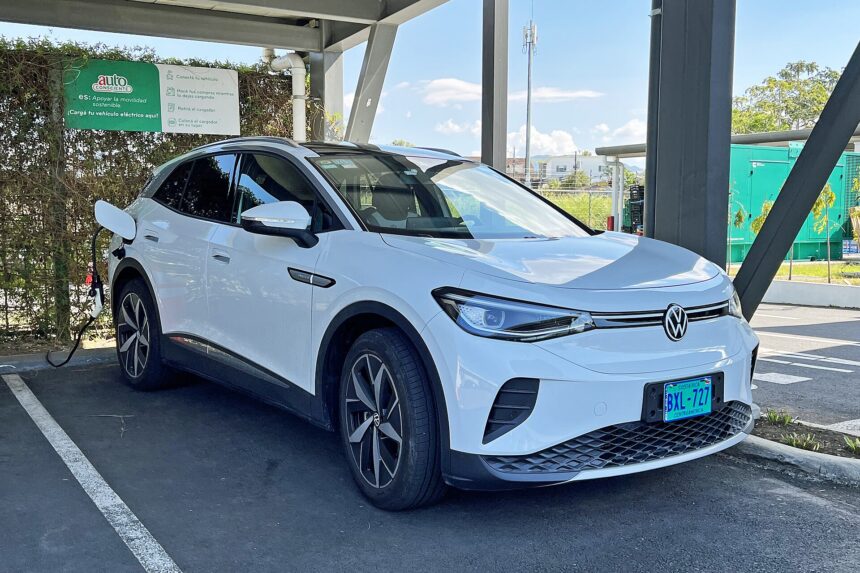
Volkswagen is recalling 72,668 electric vehicles worldwide because some of their battery cells do not meet specifications, Electrek reported, citing Germany’s Federal Motor Transport Authority. The recalls cover certain ID. Buzz, ID.3, ID.4 and ID.7 models built from 2022 to 2025, plus Cupra Born hatchbacks built from 2022 to 2024. Volkswagen said certain charging profiles combined with a charge above 80 percent may trigger thermal propagation, the chain reaction that can turn one bad cell into a battery fire.
The interim remedy does not involve a mechanic. Where technically possible, the car’s software will temporarily limit charging to 80 percent, Volkswagen said. A permanent repair has not been finalized, Electrive reported.
This is what a recall looks like in the software era. The safety measure reaches cars in days, without a dealer visit. But the fix that removes the risk is still being developed, and in the meantime owners give up a fifth of their battery’s capacity for an indefinite period.
What is being recalled
The worldwide figure spans three recall campaigns, including 9,881 cars in Germany, according to Electrek. Volkswagen told Handelsblatt that individual high-voltage cells failed quality requirements because of manufacturing errors at suppliers, Electrive reported. The authority said it knew of no incidents involving injury or property damage, and Electrive described the recall as precautionary.
In the U.S., the recall covers 22,524 ID.4 SUVs from model years 2023 to 2026, built between January 2023 and February 2025, according to Batteries International. Volkswagen estimates that only about 0.1 percent of the recalled vehicles actually have the defect. Electrive identified the cell supplier for the U.S. vehicles as SK Battery America.
EV commentator Alex Voigt summarized the European filing on X:
VW recalls BEVs Because of Battery Issues
VW's battery recall is now official with the 🇩🇪 German Federal Motor Transport Authority (KBA).
A fire hazard may result from a manufacturing defect at a supplier's facility
It affects about 72,700 EVs worldwide and about 10,000 in…
— Alex (@alex_avoigt) October 21, 2026
The cap arrives by default
The U.S. rollout shows how the new model works. Volkswagen emailed ID.4 owners saying that unless they opted out by October 21, it would apply a temporary vehicle setting limiting charging to 80 percent. The change is made remotely and was expected to show up in the owner app on or about October 27, Electrek reported. Formal letters to owners are not expected until November 27, and the remedy itself is “currently under development,” according to the federal filing quoted by Batteries International.
In other words, the restriction is in place weeks before the official recall letter arrives, and the end date depends on a fix that does not yet exist. In Germany, the cars will need a workshop inspection of the battery or its modules before the limit can be lifted, Electrive reported, citing Handelsblatt.
For owners, an 80 percent ceiling can be more than an inconvenience. On short daily trips it may go unnoticed. On a road trip, a cold morning or a long commute, the top fifth of the battery is the part that matters. A car bought for a certain range now has less of it, for reasons the owner had nothing to do with, and no date for when it returns.
A pattern in the U.S. ID.4
The October recall is not the first battery-fire recall for the American ID.4. Two recalls in early 2026 covered a combined 44,551 ID.4s built at Volkswagen’s Chattanooga plant with SK Battery America cells made in Georgia, citing problems including misaligned electrodes in individual cells, Electrive reported. Batteries International also cited a December 2025 recall of 629 ID.4s for battery fire risk. The reports do not say whether some vehicles are covered by more than one recall.
Repeated recalls tied to the same model and supplier raise a question that a software limit cannot answer: whether quality control at the cell level has been fixed, or whether each recall is catching another batch of the same kind of problem.
The case for Volkswagen’s approach
There is a strong argument that Volkswagen is doing the responsible thing. No injuries or property damage have been reported. The company’s own estimate is that about one car in a thousand is affected, and it cannot easily tell which one. Capping every car remotely protects all of them immediately, instead of waiting months for parts and service appointments while owners keep charging to 100 percent.
Remote updates also make this kind of caution cheaper. Without remote access, a manufacturer facing a one-in-a-thousand risk is left with a costly physical recall or a written warning that depends on every owner reading it and acting on it. A software cap is a third option, and it is better than either of those for the owner whose car has the bad cell.
The cost is that a quick, cheap interim measure removes the urgency to deliver the real fix. The test for Volkswagen is not how fast it capped the batteries. It is how long it takes to give owners back the car they paid for.
Related reading: A year without the $7,500 EV credit: electric cars fell back to 5.8%; Tesla’s Roadster was promised for 2020. Now it’s 2028.