
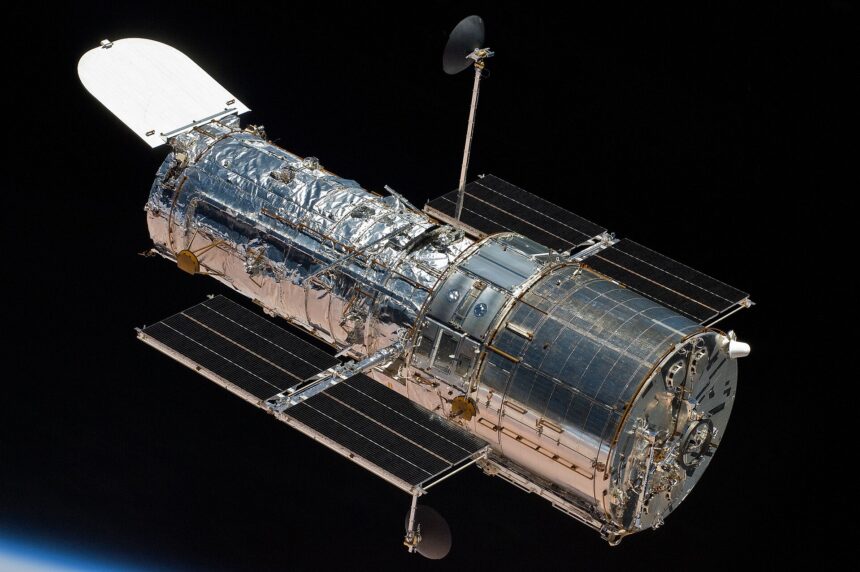
NASA has put a deadline on the Hubble Space Telescope. On Oct. 29, the agency issued a request for information asking companies what they could offer to boost Hubble to a higher orbit, service it, or bring it down in a safe, controlled reentry. NASA’s analysis says the telescope will likely reenter the atmosphere in 2033 or 2034, so any mission would need to fly by 2032. Responses are due Nov. 30.
The request lands five weeks after the last attempt to rescue a NASA telescope fell out of the sky. Katalyst Space’s Link spacecraft, sent to catch and lift NASA’s Swift observatory in a $30 million effort, the AP reported, lost two of its three reaction wheels, burned through its fuel recovering from a spin, and reentered on Sept. 25 without ever grabbing its target. Swift was expected to follow it down in early November.
My take: this request is less a rescue plan than a market test. NASA is asking whether commercial satellite servicing is mature enough to bid on a fixed, unforgiving deadline with the most famous telescope ever built. And because the request also asks about disposal, I think NASA is starting a purchase it will have to make one way or another. The open question is whether it buys Hubble more years or a safe funeral.
What NASA is actually asking for
The request names three options: a boost to extend Hubble’s science life, servicing to improve its capabilities, and a controlled reentry or orbital disposal. According to TNW, citing Ars Technica, any boost must take Hubble to at least 600 kilometers and must not harm the telescope, and the contractor would supply the rocket, the servicing spacecraft, operations, and a crew if one is needed. The same report says NASA is not committing to buy a mission and has no money set aside for one. Hubble has no engine of its own, and its orbit was last raised by the shuttle Columbia in 2002.
NASA Administrator Jared Isaacman said in the agency’s announcement that NASA “should be looking at every reasonable opportunity” to extend Hubble’s life. Isaacman is not new to this question: as a private astronaut in 2022 he offered to pay for most of a crewed Dragon mission to Hubble, TNW noted, and NASA received eight industry responses to a similar request that year before deciding in 2024 not to pursue a reboost.
At the time, reporter Jeff Foust relayed NASA’s reasoning for passing:
Clampin: after reviewing commercial options for rebooting Hubble (like NASA/SpaceX study), we have elected not to pursue any at this time; concern about risks of premature loss of science. Could revisit it in the future.
— Jeff Foust (@jeff_foust) June 4, 2024
Why Swift matters more than the Dragon offer
The 2024 decision turned on risk to the telescope. Swift is the first real data point on that risk from a commercial, robotic rescue, and the lesson is not that capture is impossible. Link got within about 12 to 15 kilometers of Swift and photographed it, the AP reported. It failed on ordinary spacecraft problems: electronics, a bad valve, and a fuel budget with no margin left. NASA’s Shawn Domagal-Goldman said the attempt gave the agency valuable practice for future rescues.
That is exactly why Hubble is a harder sell than its fame suggests. Swift had been in orbit since 2004 and was going to fall regardless, so a failed rescue cost NASA a spacecraft it was about to lose anyway. A failed Hubble mission that damaged the telescope would end the science early, which is the outcome NASA cited when it walked away in 2024. The requirement that a boost “not harm the telescope” is doing a lot of work in this request.
A crewed mission avoids some of the robotic risk but brings its own clock. SpaceX plans to retire Crew Dragon by 2030, TNW reported, which leaves a narrow window for a crewed visit before the 2032 target.
The case for letting Hubble go
The strongest argument against a rescue is money, not engineering. NASA spent $98.8 million operating Hubble in fiscal 2025, Gizmodo reported in June, and the agency has been weighing that cost against the science it returns and the newer missions the money could fund. Domagal-Goldman said then that NASA was open to a reboost but first had to bring operating costs down, noting the telescope was built in a different era and is more costly to maintain.
Seen that way, a reboost is a commitment to keep paying for an aging telescope for years more, on top of whatever the boost itself costs. And the risk runs both ways: an attempt that damages Hubble would take away the remaining science sooner than simply waiting for its orbit to decay.
There is a counter to the counter. Astronomers do not expect a replacement for Hubble’s visible and ultraviolet vision before NASA’s Habitable Worlds Observatory in the 2040s, TNW reported. And NASA has to deal with the telescope’s end either way, since an uncontrolled fall carries a small risk to people on the ground. Some spending on Hubble is coming no matter what NASA decides.
What to watch
What I’ll be watching first is who answers the request on SAM.gov, and how soon they say they could fly. If the answers come back as robotic missions from young servicing companies, NASA is effectively being asked to bet Hubble on a technology whose first try at a NASA science satellite, Swift, ended without a capture. If they come back as crewed missions, the Dragon retirement date becomes the real deadline.
I’d argue the most telling number will be the price of the disposal option. If a controlled reentry costs nearly as much as a boost, the case for buying Hubble another decade gets much stronger. If it is far cheaper, NASA’s budget pressure will probably decide the outcome before the engineering does.
Related reading: Starship Finally Reached Orbit With 26 Starlink Satellites · Ukraine Wants a Satellite Network It Controls