


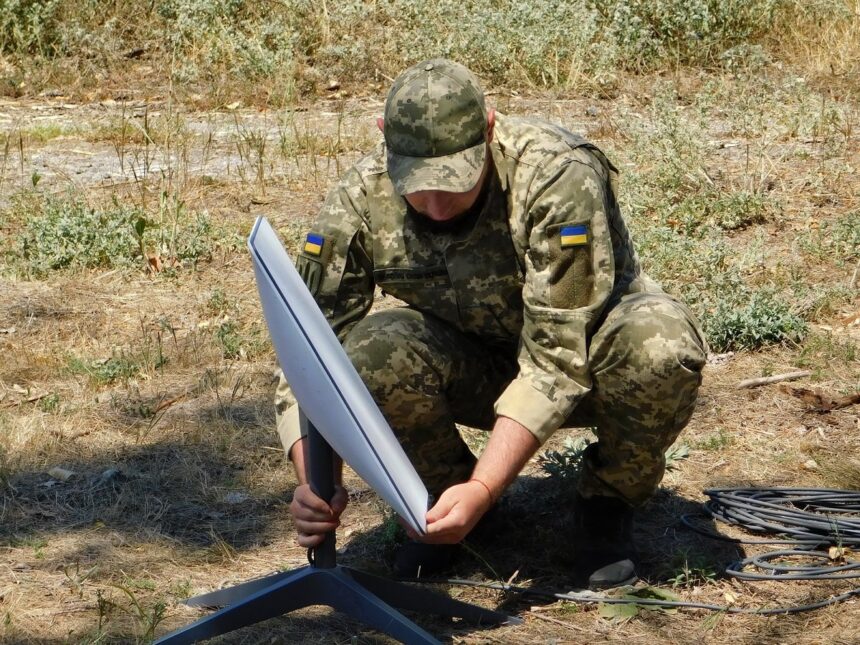
In mid-October, Ukraine’s military found that its access to SpaceX’s Starshield service, the military version of Starlink, had been slowed on moving platforms, affecting its ability to guide drones, Via Satellite reported. Within days, Ukraine’s Defence Ministry signed a letter of intent with two Finnish companies, Nokia and the satellite maker ICEYE, to explore building a satellite communications system of its own.
Nokia announced the agreement on X:
Nokia and @iceye_global announced today a partnership with the Ministry of Defence of Ukraine to develop sovereign satellite communications. Through this Letter of Intent we will explore how trusted, sovereign satellite communications can strengthen Ukraine's resilience and give… pic.twitter.com/2i0WMSHPQw
— Nokia (@nokia) October 22, 2026
The letter of intent is a first step, not a network. But the episode that prompted it is one of the clearest illustrations yet of a problem that reaches far beyond Ukraine.
What happened to Ukraine’s connection
On October 13, Ukrainian officials said sudden restrictions on Starlink services had left the military scrambling, Al Jazeera reported. Who ordered the slowdown is disputed. Elon Musk said any decision to restrict Starshield would come from the U.S. government, while the Wall Street Journal reported that Musk himself ordered it after discussions with the White House, according to Via Satellite. Al Jazeera described Musk and Trump administration officials as trading blame. President Trump later said Musk had restored access.
Service did not fully recover right away. A source in Ukraine’s Defence Ministry told Al Jazeera that instances of signal loss were still being observed with Starshield.
What Ukraine signed
The letter of intent was signed during Finnish Prime Minister Petteri Orpo’s visit to Kyiv. It commits the parties to explore a sovereign system built on European technology, and Via Satellite noted the announcement was light on details. ICEYE, best known for radar imaging satellites, and Nokia announced a partnership earlier in October to develop satellite communications that give countries ownership and control of the satellites, ground stations and terminals.
ICEYE chief executive Rafal Modrzewski said Ukraine needs secure, sovereign, high-performance satellite communications that it controls. Mikko Hautala, chairman of Nokia Defense, said nations need communications they can rely on in every situation. No timeline or funding has been disclosed.
The real issue is control, not technology
Starlink has been central to Ukraine’s military communications throughout the war. I think that is exactly what makes the October episode so significant. A military that depends on a single privately owned network depends on whatever its owner, or the government its owner answers to, decides on a given day. Ukraine learned that without changing anything on its side, its connectivity could be slowed and then restored by decisions made elsewhere.
I’d argue that lesson applies well beyond the battlefield. Many governments, businesses and remote communities rely on satellite internet, and the leading provider is a single company. The pitch from Nokia and ICEYE is not that they can beat Starlink on performance. It is that the customer would own the system, so no outside party could switch it off.
The case for staying with Starlink
There are strong practical arguments against reading too much into a letter of intent. Starlink’s scale took years of launches to build, and any new system would take years to catch up. A sovereign system would also be expensive, and Ukraine needs connectivity now. From that view, the realistic goal is not replacing Starlink but adding a backup so that no single decision can cut Ukraine off.
It is also fair to note that access was restored, and that Starlink has been a mainstay for Ukraine since the start of the war. A single disruption, however alarming, does not erase that record.
What to watch
My take is that the signals worth trusting are concrete ones: a signed contract with funding, a launch schedule, and terminals in Ukrainian hands. Watch also for whether other European governments, which Via Satellite said are facing new calls to reduce their reliance on Starlink, put money behind similar projects. Until then, one of Ukraine’s most critical communications networks will remain one it does not control.
Related reading: Starship Finally Reached Orbit With 26 Starlink Satellites. · The FCC Says 99.7% of Americans Can Get Satellite Broadband.