


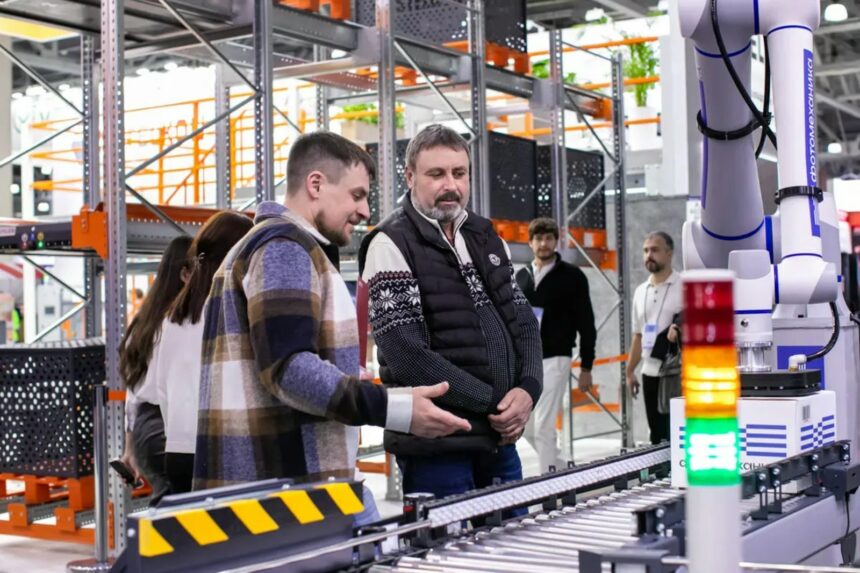
While generative AI dominates the headlines and the funding rounds, a different kind of automation is quietly restructuring one of the largest economic sectors on the planet. Autonomous robotics in logistics isn’t a future trend — it’s a present-tense industry shift that’s already reshaping how goods move from factory floors to front doors. And the companies leading this transition are building something far more durable than the average AI startup.
The numbers tell a story that most technology coverage ignores. Global industrial robot installations hit a record $16.5 billion last year. Amazon now operates over a million robots across its warehouse network. DHL Supply Chain runs more than 7,500 autonomous units across 220 countries, with over 90% of their facilities deploying at least one automated solution. This isn’t a pilot program or a proof of concept. It’s an industry-wide transformation happening at scale, and the venture capital flowing into it suggests the biggest shifts are still ahead.
The three technologies driving the shift
Not all robotics are created equal, and the logistics revolution is being powered by a specific set of technologies that have crossed the threshold from experimental to commercially viable.
Autonomous Mobile Robots (AMRs) are the workhorse. Unlike the older automated guided vehicles that followed fixed paths, AMRs use sensors and AI to dynamically plan routes, avoid obstacles, and work alongside human employees without requiring structural modifications to existing facilities. Companies like Locus Robotics, 6 River Systems, and Fetch Robotics have built fleets that can be deployed in weeks rather than months, and scaled up during peak seasons without permanent capital commitments. The flexibility matters enormously — it means a mid-market e-commerce operator can adopt the same core technology that powers Amazon’s fulfillment network, without Amazon’s capital budget.
AI-powered picking and sorting is solving the hardest problem in warehouse automation. For years, the bottleneck wasn’t moving goods around a warehouse — it was the actual grasping, identifying, and placing of individual items. Startups like Covariant have trained robotic arms to handle everything from lipstick tubes to lawnmower parts, using computer vision and reinforcement learning that improves with every pick. This is the technology that turns a warehouse robot from a glorified conveyor belt into something approaching a flexible human worker — at a fraction of the labor cost and without shift changes.
Digital twins are becoming the planning layer. At CES 2026, Siemens unveiled new digital twin capabilities that connect real-time operational data with AI-driven simulation, allowing logistics operators to model warehouse flows and transportation scenarios before making physical changes. The ability to run "what if" scenarios on your entire supply chain — before committing capital — is transforming how companies plan facility expansions, route optimizations, and workforce allocation.
Where the money is going
The investment landscape for logistics robotics reveals a market that’s maturing rapidly, with capital shifting from pure hardware plays to integrated platforms and service models.
Dyna Robotics recently raised $120 million at a $600 million valuation to advance general-purpose robots — a bet that the same AI driving warehouse automation can extend into manufacturing, healthcare, and retail. The broader robotics market is surging, with global industrial installations hitting records as AI-integrated cobots drive demand across sectors facing persistent labor shortages.
But the most significant funding trend isn’t the headline-grabbing mega-rounds. It’s the rise of Robotics-as-a-Service (RaaS). Companies like inVia Robotics lease fleets of robots along with software and support, allowing smaller warehouses to adopt automation with lower upfront costs. This model mirrors what AWS did for cloud computing — turning massive capital expenditure into predictable operating expense — and it’s opening the logistics robotics market to tens of thousands of mid-market companies that couldn’t justify a $10 million warehouse retrofit.
Notion Capital’s $130 million European growth fund explicitly targets supply chain logistics alongside AI and defense, reflecting how mainstream investors now view logistics automation as a core infrastructure play rather than a niche industrial bet. European venture firms like BDC’s $200 million Industrial Innovation fund are making similar bets on automation in traditional industries.
The industry shift thesis nobody’s pricing in
Here’s what makes logistics robotics fundamentally different from most technology trends: the demand driver isn’t hype or executive FOMO — it’s structural labor economics that aren’t going away.
The global logistics industry faces a chronic and worsening labor shortage. Warehouse work is physically demanding, turnover rates exceed 100% annually at many facilities, and the demographics in major markets are moving in one direction: fewer working-age adults willing to do repetitive manual labor. AI is rewiring logistics at global scale not because companies want to be cutting-edge, but because they literally cannot hire enough people to move their goods.
This creates a demand curve for robotics that’s unusually durable. Unlike consumer AI applications where adoption depends on convincing people to change behavior, logistics robotics solves a problem that companies are already desperate to fix. Every warehouse operator knows their labor costs are rising, their workforce is aging, and their peak-season staffing challenges are getting worse. Autonomous robotics isn’t competing with a satisfactory status quo — it’s the only viable response to a structural economic problem.
The Asia-Pacific region is accelerating this dynamic. The warehouse automation market in APAC is projected to reach $119.5 billion by 2035, growing at 18.2% annually, driven by China, Japan, South Korea, and India investing heavily in advanced warehouse technologies. As manufacturing continues shifting across Asian markets, automation infrastructure follows — and the companies building that infrastructure are scaling globally.
Beyond the warehouse walls
The logistics robotics revolution isn’t stopping at the warehouse door. Autonomy is extending into last-mile delivery, with companies like Neolix debuting Level 4 autonomous delivery vehicles at CES 2026 that don’t rely on high-definition maps — dramatically lowering deployment costs for dense urban environments. Autonomous yard trucks from companies like Outrider are handling the unglamorous but critical work of moving trailers between loading docks, eliminating one of the most dangerous and difficult-to-staff positions in logistics.
The convergence of warehouse automation, autonomous yard operations, and last-mile delivery robotics is creating something new: an end-to-end autonomous logistics chain where goods move from manufacturing to consumer with decreasing human intervention at every stage. We’re not there yet — human workers remain essential for exception handling, quality control, maintenance, and robotics coordination — but the trajectory is unmistakable.
What this means for investors and operators
For venture investors, logistics robotics represents one of the more compelling risk-adjusted opportunities in the current market. The demand is structural and growing. The technology has crossed the commercial viability threshold. The business models — particularly RaaS — create recurring revenue with high switching costs. And unlike many AI plays, logistics robotics companies can point to concrete, measurable ROI: faster throughput, lower error rates, reduced labor costs, and improved workplace safety.
The companies to watch aren’t necessarily the ones building the most impressive robots. They’re the ones building the best orchestration layers — the software that coordinates fleets of different robots, integrates with existing warehouse management systems, and provides the data analytics that justify continued investment. Enterprise technology in 2026 is increasingly about integration, not individual capabilities, and logistics robotics is no exception.
For operators, the message is simpler: if you’re running a warehouse, distribution center, or fulfillment operation and you haven’t started evaluating automation, you’re already behind. The RaaS model has eliminated the capital barrier. The labor market has eliminated the option of doing nothing. And the companies that build automation capabilities now will have a compounding advantage over the next decade as the technology improves and the labor squeeze intensifies. The quiet revolution in logistics isn’t quiet because it’s small. It’s quiet because it’s so obviously necessary that the people living it don’t bother calling it revolutionary.