

Most enterprise finance and IT leaders think of their corporate mobile connectivity program as a line item. A monthly carrier invoice, a headcount for managing it, and an occasional contract renewal that nobody looks forward to. The business phone plan has never received the same attention as email, identity, or devices, and most organizations have simply accepted that as the natural order of things.
But the real cost of enterprise mobile plan management is distributed across IT overhead, security incidents, productivity drag, and compliance exposure. None of those appear on any carrier bill, and taken together, they make an organization’s employee phone plans look less like a manageable procurement category and more like a structurally underoptimized problem that has been tolerated because nobody had a better option.
When IT leaders stop looking at the invoice and start asking what the best employee phone plan provider for enterprises delivers, the answer looks nothing like a carrier relationship. It looks like a managed platform.
The carrier invoice is only the beginning
The numbers that do show up on the invoice are already striking. In the United States alone, companies spend $1,200 per employee each year just to keep staff connected, with roaming fees adding $690 per traveler per trip on top of that. Globally, businesses waste an estimated $65 billion a year on telecom inefficiencies ranging from unused lines to opaque contracts. Half of all telecom contracts don’t fully meet user needs, not because procurement teams are inattentive, but because they are managing separate carrier relationships by country. And since every country comes with its own contract terms, renewal cycles, and invoicing formats, this makes consolidating an entire business’s invoices in one platform borderline impossible.
But these are the costs finance teams realistically track. The ones they don’t are even larger.
IT teams lose more than a third of their time managing mobile devices and their respective connectivity, as every employee’s question about coverage, roaming, plan changes, or activation leads to a support ticket that requires having telecom-specific knowledge, a category that scales with headcount and that most enterprise helpdesks were never designed to absorb. This is further compounded by the fact that when employees travel internationally, 34% of workers cite poor mobile connectivity as a major frustration, dealing with dropped calls, slow connections, and wasted time spent reconnecting. That figure can’t be measured to show in an organization’s mobile connectivity budget, but it’s an important factor for every employee who travels.
The security cost is the most consequential omission. Zscaler’s ThreatLabz 2025 Mobile Threat Report showed malware transactions increased 67% year over year, fueled by sophisticated spyware targeting enterprise devices. Unmanaged personal devices accessing corporate systems, active lines never deactivated once an employee leaves, and BYOD arrangements that bypass the security perimeter, these are all problems that represent material risk exposure that a company’s risk teams have to account for.
Why the carrier-direct model was never built for what enterprises need
The commercial relationship between enterprises and mobile carriers was, first and foremost, built around the conditions laid out by the carrier’s distribution model. For companies dealing with employees stationed in multiple countries, that means repeating a separate procurement process for every market, meaning constant, redundant processes of negotiation talks, contracts, renewal cycles, and invoices. What should be a single managed category becomes a permanent procurement exercise that consumes IT, finance, and legal bandwidth year after year, with no consolidated view at the individual or global level.
Each carrier runs its own portal with its own login and its own reporting format. So an organization with carriers across five countries has five main sources of information that should live in one place. IT teams end up reconciling data across disconnected systems with no single source of truth for which lines are active, what they cost, or how they are being used across the workforce.
The provisioning workflow that falls out of all this is manual, slow, and disconnected from the identity and IT systems dealing with every other access credential in the organization. A new employee’s corporate line gets provisioned through a carrier portal manually and separately from when other onboarding tasks are completed.
The deprovisioning side is where the structural problem turns into a security incident. When an employee leaves, their corporate phone line is frequently still active weeks later because the process for cancelling a SIM lives in a completely separate system, managed by a separate team, on a completely separate timeline from the automated offboarding workflows that handle email, device management, and system access. Those orphaned lines can, over time, lead to mass data breaches, remaining tied to authentication tools long after the employee has gone.
The carrier-direct model isn’t broken in the sense of failing to deliver carrier access and billing at scale. It was simply not designed for a world where enterprises expect their mobile connectivity program to behave like every other managed system in their stack.

Why the business case for reform is straightforward
These costs aren’t the result of bad procurement decisions or inattentive IT teams. Rather, they’re the predictable output of a business phone plan model that was never designed for the many requirements of a modern enterprise. And the longer that model stays in place, the more each of those cost categories compounds.
The security ROI is the most immediate argument. A single mobile-related breach, covering investigation, remediation, regulatory notification, and reputational damage, costs orders of magnitude more than the annual cost of a platform dealing with deprovisioning and eliminating the orphaned lines that lead to an exposure in the first place.
The productivity ROI magnifies it. By replacing days-long SIM shipping delays with instant eSIM activation, and eliminating the roaming cost that pushes employees toward unsecured public WiFi, a centralized phone plan management platform recovers real revenue and time-to-productivity gains that dwarf whatever platform investment is required to deliver them.
What those organizations who shift to a business phone plan management platform consistently report is the same set of outcomes. IT teams get back the time that was going into manual provisioning. Finance finally has consolidated, predictable spend visibility across all markets in a single place. Procurement stops spending bandwidth on annual carrier renegotiations across multiple simultaneous relationships. Each of those is a positive return, but together, they make the business case straightforward.
The reform conversation doesn’t need to start off with a total cost calculation. It needs to come with a much simpler question: What is the best employee phone plan provider for enterprises? The answer isn’t the cheapest carrier, nor the one with the most coverage maps. It’s the one that treats business phone plan provisioning with the same level of importance as the rest of the enterprise stack. That answer is Gigs.
What a purpose-built enterprise phone plan platform looks like with Gigs
Most enterprise mobile phone plan management tools are consumer or wholesale mobile products adapted for enterprise use after the fact. Gigs, the embedded telecom OS that powers Gigs for Work, was built from the ground up around the provisioning, management, visibility, and security requirements of a large organization managing mobile the same way it manages email, identity, and devices.
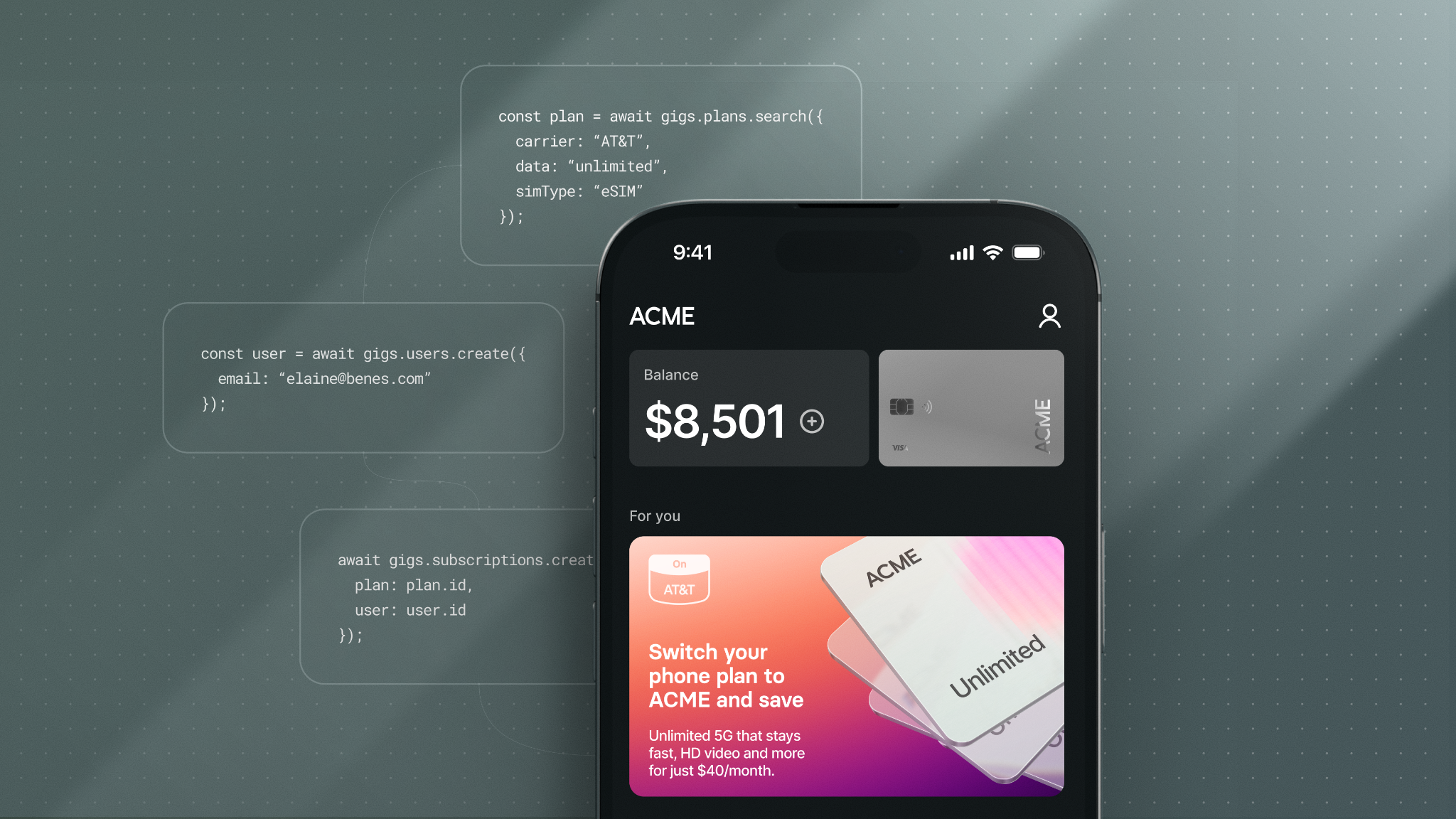
When a new employee joins, their corporate line is provisioned automatically through workflows that come triggered by the company’s existing IT and identity systems, then delivered instantly via email, Slack, or Teams with no IT involvement required. Plan configuration follows organizational policy. When an employee leaves, their eSIM is deactivated automatically through the same offboarding workflow, the same way every time, never requiring IT to intervene manually.
Every active line, enrolled device, plan configuration, and anomaly of usage is visible in a single dashboard that immediately integrates with the security and compliance protocols the organization already uses. Gigs consolidates phone plans across 50 countries and more than 195 roaming markets, replacing carrier portal sprawl and invoice fragmentation with a single integration, a single dashboard, and a single invoice.
Employee phone plan management as a strategic infrastructure decision
For enterprise leaders who have spent years asking what is the best employee phone plan provider for enterprises without finding a satisfying answer in the carrier market, Gigs reframes the investment from a platform cost to a cost reduction. It tackles the IT overhead eliminated through provisioning automation, the security incidents prevented through centralized visibility and automated deprovisioning, the compliance exposure reduced through policy enforcement, and the productivity gains delivered through a mobile connectivity program designed around how employees use phones on a day-to-day basis.
Each of those represents a return that makes the platform cost easy to justify against the total cost of the carrier-direct model it replaces.
Business phone plans have been treated as a line item for too long. Using Gigs is what it looks like when it finally gets the same attention as every other critical system in the stack.