

For sixteen years, Apple’s best-known answer on touchscreen Macs came from Steve Jobs. In 2010 he said Apple had tested the idea and that “touch surfaces don’t want to be vertical,” as Cult of Mac recalled this week. Your arm gets tired, he argued, and the trackpad is the better answer.
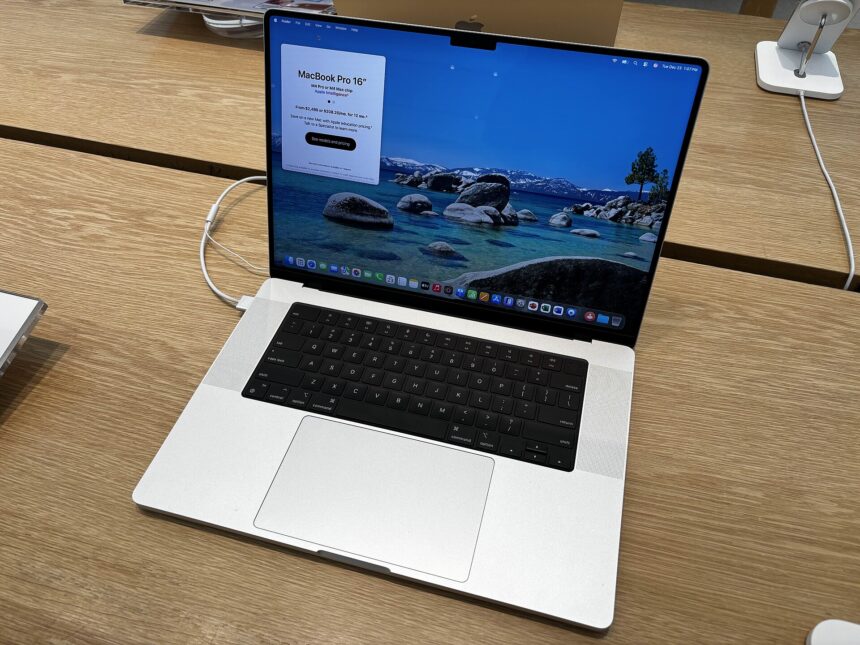
On Wednesday Apple reversed that. The new MacBook Pro with a tandem OLED “PROLED XDR” display has a touch sensor built into the panel, and it starts at $2,899 for the 14-inch model and $3,399 for the 16-inch. Pre-orders are open now, and the machines launch Friday, November 6.
The surprise isn’t that Apple finally did it. It’s how little Apple changed to do it. According to Apple, macOS automatically translates touch into clicks, so existing apps work with a finger right away. My take: Apple has shipped a touchscreen without yet shipping a touch Mac. The hardware is here. Software designed for fingers is a later decision, and the way Apple has priced this machine gives developers little reason to make it for them.
What Apple actually announced
The touch features Apple showed are the familiar ones: swipe to scroll, pinch to zoom, drag items around, and double-tap a window to fill the screen, MacRumors reported. The machines run the same M5 Pro and M5 Max chips Apple put in the MacBook Pro in March. The notch is replaced with a Dynamic Island.
What’s missing matters too. No version of Apple Pencil works with the new MacBook Pro, Cult of Mac noted, and touch is not meant to be the main way to use it. The keyboard and trackpad remain the primary interface.
Apple CEO John Ternus promoted the launch on X:
We’re glowing with excitement over the new MacBook Pro. You’ve gotta touch it to believe it. pic.twitter.com/BLiGkGaefL
— John Ternus (@johnternus) October 28, 2026
Touch is a $400 feature, for now
Apple is not replacing its existing laptops. The OLED models are sold alongside the mini-LED models, which have no touchscreen, and Apple priced the OLED versions $400 above comparable mini-LED configurations. The cheapest MacBook Pro of all, a refreshed 14-inch model with the new M6 chip, starts at $1,999 and otherwise keeps the previous design, which means no touch.
That pricing tells you who Apple expects to buy a touch Mac this year: people already paying close to $3,000 for a laptop. It also fits a pattern on Apple’s price sheet this fall. The new OLED iPad mini, announced two days earlier, starts at $699, up from $499 at its 2024 launch and $599 after a June price increase.
Here is why the price matters beyond the buyer’s wallet. Developers redesign apps when enough of their users have a new kind of input. With touch limited to the top of one product line, and the $1,999 MacBook Pro, the iMac and the rest of the Mac lineup all still built around a pointer, the share of Mac owners who can touch their screen will start very small. I’d argue that’s the real reason Apple leaned on click translation: it is the only way touch works at all in the near term, because few apps will be rebuilt for it.
Why “translates touch into clicks” is the key phrase
Treating a tap as a click is a sensible bridge, but it is a bridge. macOS buttons, menus and window controls were sized for a pointer that can land on a few pixels. A finger can’t. That is the core of the skepticism around the launch, which Cult of Mac described as a great deal of resistance to a touch-enabled Mac before the announcement.
Apple has the tools to go further: it controls both macOS and iPadOS, which was built for fingers from the start. Choosing not to adapt the Mac interface on day one looks deliberate: it keeps the Mac looking like a Mac for the large majority of users who will never touch the screen, and it avoids the “iPad-ification” that critics of a touch Mac fear.
The case for doing it this way
There is a strong argument that Apple got this exactly right. Starting with click translation means nothing breaks. Every app a professional relies on works with touch on day one, even if clumsily, and no one is forced to change how they work. Touch is an addition, not a replacement for the trackpad Jobs defended.
It’s also hard to call touch alone a $400 upcharge. The premium buys the OLED panel as well, which Apple rates at up to 2,000 nits and a 10,000,000:1 contrast ratio, per MacRumors. Many buyers will be paying for the screen and getting touch as a bonus. And if touch eventually moves down to cheaper models, today’s small installed base is a starting point, not a ceiling.
I find that persuasive as far as it goes. It’s a good way to ship a first touch Mac. It just isn’t the same as Apple committing to touch as a Mac interface, and buyers paying $2,899 should know the difference.
What I’ll be watching
Three things. First, reviews after November 6: how often people actually reach for the screen once the novelty fades, and which macOS controls prove too small for a finger. Second, whether Apple’s next major macOS release includes real touch-specific changes, such as larger hit targets when a finger is detected, rather than relying on click translation. Third, whether touch moves down to the $1,999 MacBook Pro or the MacBook Air in the next hardware cycle.
If all three happen, Wednesday will look like the start of a new kind of Mac. If touch stays confined to top-tier laptops, I think it will read as a luxury add-on rather than a platform shift. Jobs’s line about vertical screens has finally been retired. Whether Apple has actually answered his argument about ergonomics is still open.
Related reading: An Apple TV and Two HomePod Minis Cost $350 in June. The New Versions Cost $600. · Apple Raised the Price of a Year-Old iPhone by $100 · Microsoft’s AI Laptop Starts at $2,599 · Google’s $899 Googlebook Is Android’s Answer to the Mac