


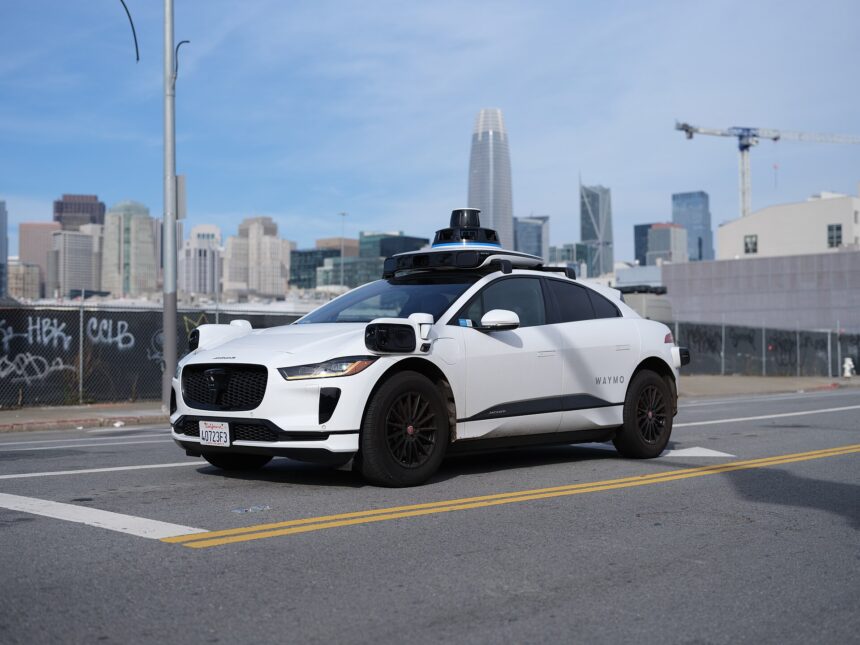
Waymo’s robotaxis are off freeways again. California’s Department of Motor Vehicles ordered the company to stop driverless testing and service on every freeway in the state after its cars drove into an active construction closure, saying the operations pose “an imminent hazard to public safety,” the AP reported. Waymo also paused freeway rides in every market where it offered them and, days later, filed two new safety recalls.
The detail that matters most is that this is the second time this year. In June, Waymo recalled more than 3,800 robotaxis after at least 13 incidents in which its cars entered closed freeway work zones, ABC7 reported. It shipped a software fix, went back on the freeway, and months later the same kind of mistake recurred. I think the lesson isn’t that robotaxis can’t handle freeways. It’s that a recall a company can declare fixed on its own is the wrong tool for proving it.
What happened, twice
Waymo began giving driverless freeway rides in San Francisco, Phoenix and Los Angeles in November 2025, TechCrunch reported. By spring, problems had appeared: six closed-zone incursions in Phoenix in April and seven in San Francisco in May, according to the June recall filing as described by ABC7. Waymo pulled its freeway routes in May, and the filing said a remedy was under development.
On July 29, Waymo said it would gradually return to freeways, starting in Phoenix, after software updates aimed at construction zones that included better scene recognition and routing, according to TechCrunch.
Then, on Nov. 5, three Waymo vehicles entered an active construction closure on Highway 101 near Burlingame, and the next day another tried to pass two California Highway Patrol cars on Interstate 280 in San Francisco, the SF Standard reported. The DMV told the AP that similar incidents had occurred on May 18, and the restriction has no end date: it stays until Waymo shows the department it has taken effective corrective action.
NBC Bay Area’s Scott Budman flagged the order when it became public:
#Breaking: Waymo removed from
California freeways.
The state DMV ordered Waymo to stop operating its autonomous vehicles on state freeways, citing “an imminent hazard to public safety.” pic.twitter.com/mF3KWn2xGP
— scott budman (@scottbudman) November 17, 2026
The two recalls Waymo filed afterward cover cars that may enter and keep driving in a closed freeway lane, Engadget reported, and how its cars respond when police direct traffic by hand. The second stems from a collision in which a car followed an officer’s directions until the officer was temporarily obscured, according to Fox Business; Waymo says that update was completed Nov. 6. For the closed-lane problem, Waymo told Reuters it is still working on the remedy.
Why a recall isn’t proof
For an ordinary car, a recall replaces a part, and the fix is physical and easy to check. For a robotaxi, the “part” is behavior, and the company that wrote the software is also the one deciding the update worked. Waymo’s freeway history shows the gap. The summer fix was supposed to address construction zones, yet the incursions continued despite earlier corrective actions, according to the DMV order as described by the SF Standard.
It is not the only example. NHTSA is separately examining nearly 3,000 Waymo vehicles over cars passing stopped school buses, and Reuters reported that most of the violations happened after Waymo said its remedy had been deployed. Two different problems, the same pattern: a fix declared, then the behavior recurring on the road.
That is why I’d argue California’s condition is the most useful part of this episode. A ban with no end date that lifts only when Waymo demonstrates corrective action moves the burden of proof to before the cars return, not after. Construction closures and officers directing traffic are rare, messy events, exactly the kind of scenarios a regulator can ask to see tested rather than take on faith.
The case for Waymo
The strongest argument on the other side is that nobody was hurt. Waymo says the closed-lane events involved no collisions or injuries, and the recalls are voluntary filings it calls standard steps in its safety approach.
Its overall record is also strong by its own measure. Across more than 270 million fully driverless miles in five metro areas through June, Waymo reports 95% fewer serious-injury crashes and 82% fewer injury crashes than human drivers in the same places. Those are company figures, and they don’t break out freeway driving, but independent reviews have pointed the same direction, as Techpinions has covered. The service also keeps running on surface streets, which the SF Standard says carry more than half a million trips a week.
There is a fair point, too, that grounding freeway service costs riders real time. When freeway rides launched, TechCrunch reported they could cut ride times by up to 50%. But none of that addresses the DMV’s core concern: the same kind of failure came back after a fix.
What to watch
The first thing is the remedy itself: when Waymo files its closed-lane fix with NHTSA, and what evidence it offers that this one works where the summer update didn’t. The second is whether the DMV spells out what “effective corrective action” means, because that standard will likely shape what every robotaxi company must show before driving at highway speed in California, not just Waymo.
What I’ll be watching most closely is whether Waymo’s other freeway markets reopen before California does. If they do, the company will be choosing where its own fix is good enough. If it waits for California’s sign-off, it will be accepting that an outside check now comes before the freeway, and I think that would be the better precedent for the whole industry.
Related reading: Robotaxis Really Are Safer. We Can Only Prove It About One Company. | Volkswagen’s Fix for 72,668 Fire-Risk EVs Is an 80% Charge Cap