


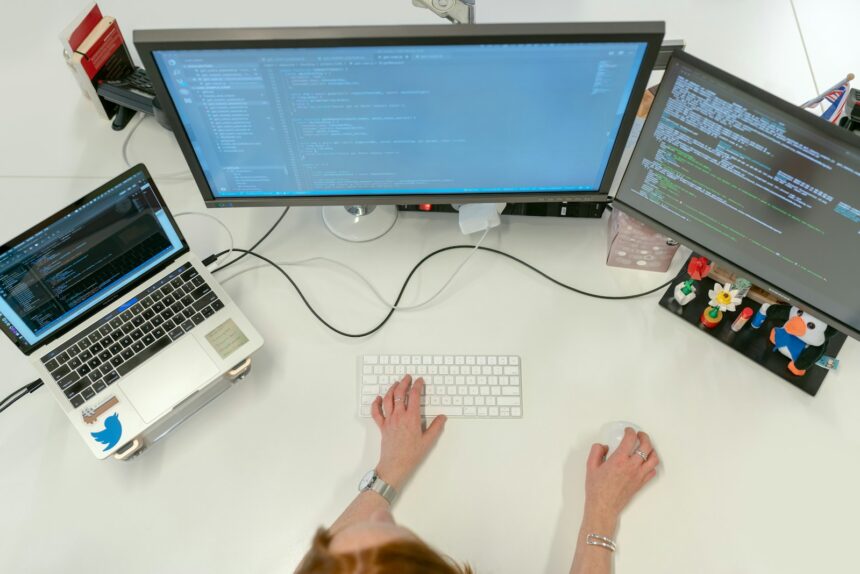
The AI industry spent 2025 obsessed with frontier model capabilities — parameter counts, benchmark scores, reasoning chains, context windows. Meanwhile, something more consequential was happening in places nobody was watching. Marketing agencies were building production SaaS products overnight. Operations managers were creating internal tools that replaced six-figure consulting engagements. Non-programmers were shipping software that works. The real inflection point for AI in business isn’t GPT-5 or Claude Sonnet 4. It’s the moment when the people who understand business problems gained the ability to build their own solutions without asking permission from an engineering team.
The term is “vibe coding” — coined by Andrej Karpathy in February 2025 to describe the practice of describing what you want to an AI and letting it write the code. The name is deliberately casual, which is partly why the enterprise technology establishment has been slow to take it seriously. That’s a mistake. More than 80% of developers are already using or planning to use AI coding tools, and 90% of Fortune 100 companies have adopted them in some form. But the numbers that matter aren’t about developers coding faster. They’re about the people who couldn’t code at all who are now building production applications.
Consider what happened at Havas, one of the world’s largest advertising holding companies. A team used Claude Code and Replit to build Brand Insights AI — a generative engine optimization platform that analyzes how brands appear across AI-generated responses. The tool has been deployed globally across nearly 100 countries and more than 60 languages, and is now licensed to clients as a SaaS product. At Broadhead, VP of product innovation Mitch Hislop vibe coded the first version of a competitive intelligence platform in a single evening. These aren’t prototypes. They’re revenue-generating products built by people whose job titles don’t include the word “engineer.”
Why this matters more than frontier model improvements
Every major AI announcement in 2026 has centered on model capabilities — bigger context windows, better reasoning, faster inference. These improvements matter. But they operate on a familiar technology adoption curve: better tools make existing professionals more productive. Vibe coding operates on a fundamentally different curve: it creates entirely new categories of builders.
The distinction is critical. When a software engineer uses Copilot to write code 40% faster, the output is incremental — the same work, completed sooner. When a marketing director uses Claude Code to build a competitive analysis tool that her team uses daily, the output is something that wouldn’t have existed at all. No project was scoped. No engineering resources were allocated. No sprint was planned. The solution materialized because the person with the problem had direct access to the means of building the solution. For enterprises still debating whether to invest in AI at all, vibe coding is rewriting the business case from the bottom up — not through top-down transformation initiatives but through thousands of small acts of creation by people who were never supposed to be building software.
Platforms like Lovable, Bolt.new, Replit, and Base44 are purpose-built for people with zero programming background. Emergent alone has reached 6 million users across 190 countries, with over 7 million applications created on its platform. The scale suggests this isn’t an early-adopter phenomenon. It’s a structural shift in who gets to build digital tools — and the enterprise implications are enormous.
The uncomfortable truth about enterprise software
Here’s what nobody in enterprise IT wants to say out loud: most internal software exists because someone needed a relatively simple tool and the only way to get it built was to submit a ticket to engineering, wait three to nine months, and accept whatever emerged from the development process. The gap between business need and delivered solution is where consultants, no-code platforms, and spreadsheet-based workarounds have lived for decades.
Vibe coding collapses that gap to hours. And the person building the tool is the person who understands the problem — which means the solution is more likely to actually match the need. The marketing director doesn’t build an overengineered platform with admin panels and user management. She builds exactly what her team needs to track competitive positioning across AI engines, and she iterates on it in real time based on actual usage. Organizations already navigating complex enterprise AI contracts may find that vibe-coded internal tools deliver more immediate value per dollar than the enterprise AI platforms they’re paying premium rates for.
This is why the enterprise software industry should be paying closer attention than it is. Every internal tool that gets vibe coded into existence is a tool that wasn’t purchased from a vendor, wasn’t built by a consulting firm, and wasn’t scoped by an IT department. The long tail of enterprise software — the thousands of small applications that organizations need but can’t justify dedicated development resources for — is being claimed by non-programmers building for themselves.
The risks are real but not where you think
The obvious objection is security. And it’s valid. Research shows that AI co-authored code contains elevated rates of logic errors, with misconfigurations 75% more common and security vulnerabilities 2.74 times higher than human-written code. When an LLM generates code, it prioritizes working code over secure code. Vibe coders — who by definition lack the expertise to audit what they’re building — are shipping applications with vulnerabilities baked into the foundation.
Forrester predicts that 75% of technology decision-makers will face moderate to severe technical debt from AI-generated code by year-end. The “vibe coding hangover” is real: an estimated 7.2% reduction in delivery stability accompanies AI adoption at scale. And the workforce pipeline creates a compounding problem — 54% of engineering leaders plan to hire fewer junior developers because of AI, but AI-generated technical debt requires exactly the kind of human judgment that junior developers develop through years of debugging experience. The engineers needed to fix 2027’s problems aren’t being hired in 2026.
But here’s the contrarian read: these risks, while genuine, are manageable — and they’re not fundamentally different from the risks that every previous wave of democratized technology introduced. When spreadsheets gave financial analysts the ability to build models without programmers, the result was bad models alongside transformative ones. When WordPress gave marketers the ability to publish websites, the result was insecure sites alongside businesses built entirely on the platform. The solution was never to restrict access. It was to build governance around the new capability. Organizations that have been quietly building private LLMs are already developing the internal guardrails — code review pipelines, security scanning, deployment controls — that can make vibe coding safe enough for production use.
What enterprises should actually do about this
The worst response to vibe coding is to ban it. It’s already happening — in marketing departments, operations teams, sales organizations, and finance groups across every large enterprise. Banning it just drives it underground, where the security risks multiply because the tools are invisible to IT governance.
The better response is to treat vibe coding the way smart organizations treated shadow IT a decade ago: acknowledge it, secure it, and channel it. This means providing sanctioned AI coding tools with enterprise security configurations. It means building lightweight review processes for vibe-coded applications that route through security scanning without creating the months-long bottlenecks that drove people to build outside the system in the first place. And it means accepting that the role of the IT department is shifting from gatekeeper of software creation to governance layer for a much broader population of builders.
The companies that will capture the most value from this shift are the ones that recognize what’s actually changing. The AI inflection point isn’t a model that scores higher on benchmarks. It’s the moment when the 95% of knowledge workers who’ve never written a line of code discovered they could build the tools they’ve been waiting years for someone else to build. That shift is happening right now, in ad agencies and finance teams and operations departments, one vibe-coded application at a time. The frontier model wars make better headlines. The vibe coding revolution will make a bigger difference.