
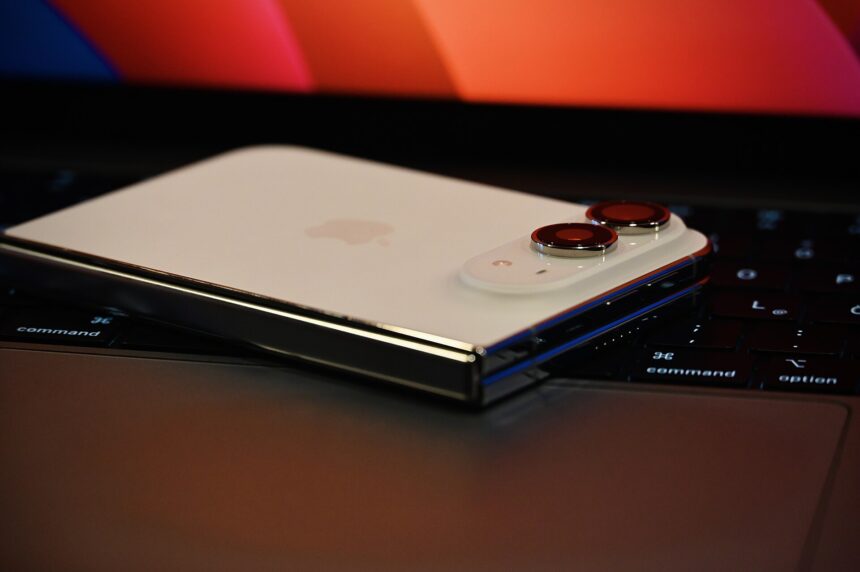
Apple’s first foldable phone sold out within minutes of preorders opening. By that morning, every U.S. configuration of the $1,999 iPhone Duo showed an estimated ship date of Jan. 25, 2027, IBTimes reported. Just over two weeks later, on Apple’s first earnings call under CEO John Ternus, the company told investors what that demand will be worth over the holidays: record revenue, and a gross margin that falls to between 45 and 46 percent.
Both numbers point to the same thing. Apple’s problem right now isn’t demand. It’s parts, and memory in particular. I think this is the most important shift in Apple’s business this year. For a decade the question was whether people would keep paying more for iPhones. They are. The question now is whether Apple can build enough of them, and how much of the cost of building them it has to absorb.
A record quarter with a catch
On paper the September quarter was excellent. Revenue was $114.5 billion, up 12 percent, and gross margin was 47.9 percent, according to Apple’s press release. iPhone revenue was $57.6 billion, up 17 percent “despite supply constraints,” CFO Kevan Parekh said on the call, according to the transcript. The Duo did not go on sale until Oct. 23, so none of it is in those numbers.
The catch is in the margin. About one point of that 47.9 percent came from tariff refunds, and Parekh said Apple has now received the vast majority of them. Without the refunds, he said, company gross margin would have been down about a point from the June quarter, mainly because of higher memory costs.
For the December quarter, Apple guided revenue growth of 7 to 10 percent, well above the roughly 5.9 percent FactSet consensus, and a margin of 45 to 46 percent, below the roughly 47 percent Bloomberg estimate, TradingKey reported. Ternus called what Apple is seeing in memory pricing “unprecedented.” The stock fell 2.81 percent after hours.
Apple chose to eat the cost on the Duo
The Duo’s price was a deliberate choice. Before launch, Bloomberg’s Mark Gurman reported that Apple had settled on a roughly $2,000 starting price while absorbing the extra memory costs:
Apple landed on the iPhone Duo name for the foldable iPhone and a $2,000 starting price, eating the additional memory costs. Storage capacities will reach 2 terabytes and roughly $3,000. It’ll ship in October, has support for the Apple Pencil and come in dark blue + white. https://t.co/58VLtVNka6
— Mark Gurman (@markgurman) September 9, 2026
Apple did not take that approach everywhere. Parekh said on the call that Apple reluctantly raised prices on a number of products, starting with iPad and Mac at the end of June and iPhone in September, according to the call transcript. Even so, the Duo starts at $1,999 and climbs to $3,199 for 2 terabytes, according to IBTimes. In other words, Apple held the line on the product that defines its year and let the margin take the hit.
The constraint isn’t only memory. Nikkei Asia reported that Apple’s strict quality checks held early Duo output to a few hundred units a day, according to Seoul Economic Daily, and Foxconn’s final-assembly yields were only slightly above 60 percent in mid-September, IBTimes reported, citing China’s Jiemian News. Ternus said Apple is working hard to get the Duo “into customers’ hands as quickly as we can,” but the company gave no date for when supply will meet demand.
Memory is also limiting products that have nothing to do with folding. COO Sabih Khan said Apple expects constraints on Mac and iPad in the December quarter, “primarily driven by memory,” because demand came in higher than expected, according to the call transcript.
The case that this is a good problem
The strongest argument against worrying is simple. Apple is guiding to growth of up to 10 percent in the holiday quarter, already its biggest of the year, and even the low end of that range beats what analysts expected. Supply limits are a problem every hardware company would trade for. Lost sales in December can turn into sales in January, as the Duo’s own waitlist shows.
Memory pricing has also historically moved in cycles. If supply catches up with demand, the cost that is squeezing Apple’s margin this winter could ease. Meanwhile, analysts still see plenty of Duo volume: JPMorgan’s Samik Chatterjee estimates about 8.5 million Duo shipments in the December quarter, IBTimes reported. That is a lot of $2,000 phones for a first-generation product.
That case is real, and I’d take it seriously. But Apple’s own executives did not describe a short squeeze. On the call, Ternus said memory prices keep rising beyond the December quarter, and Apple declined to give any outlook past it, according to the transcript. A company that expects relief soon usually says so.
What I’ll be watching
My take: the Duo sellout says less about Apple’s pricing power than it seems. Apple has already shown that people will pay $2,000 for a new iPhone. What it hasn’t shown is how long it can keep that price while a single component keeps getting more expensive. The first thing I’ll be watching is whether the Duo’s ship dates move closer before Christmas, because that’s the clearest public sign of whether yields are improving.
The second is the March-quarter guidance in late January. If margins keep falling, Apple will face a choice it has been avoiding on its most important product: raise the price of the Duo and its successors, or accept that a record-revenue company is earning less on each phone it sells. Either way, I think the defining number of Apple’s year won’t be how many foldables it sold. It’ll be how many it could build.
Related reading: Apple raised the price of a year-old iPhone by $100 · Microsoft’s 128GB AI laptop and the cost of memory · Micron’s $37.7 billion quarter and Taiwan’s first chip strike · Apple’s first touchscreen Mac starts at $2,899