


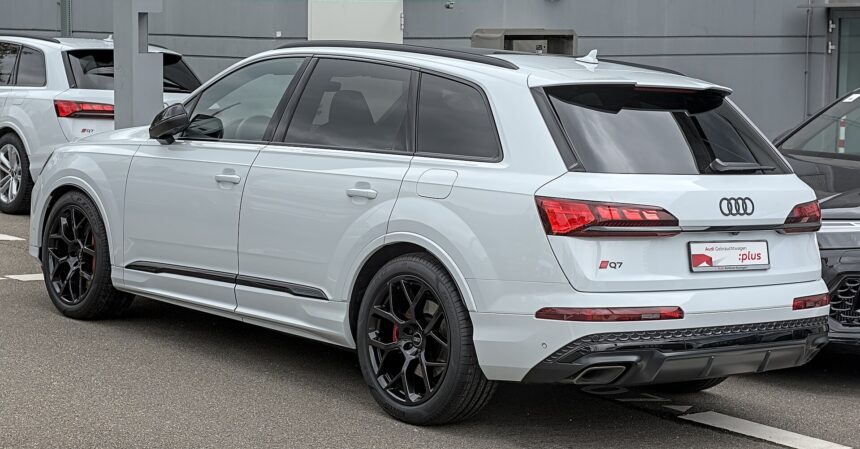
Audi will build its first U.S. factory on a 1,474-acre site in Peach County, Georgia, an investment of about $4 billion that is expected to create roughly 4,500 jobs and build up to 200,000 premium SUVs a year, according to the announcement. Site grading is scheduled for 2027, construction for 2028 and full production for 2031.
That timeline is the part worth sitting with. Tariffs on autos, steel, aluminum and parts cost Audi around €1.2 billion, or about $1.4 billion, last year, and the company imports every vehicle it sells in the U.S. from Europe or Mexico, Reuters reported. A plant that reaches full output in 2031 does nothing for those bills in 2026, 2027 or 2028.
So I don’t think this plant is mainly an escape from today’s tariffs. I think it is a bet that some version of them will still be in place in the 2030s, and that Audi sells enough big SUVs in America to make a local factory pay off either way. The clearest evidence is what a sister brand inside the same Volkswagen family just decided to do.
What Audi is building
President Trump announced the plant at a rally in Perry, Georgia, on October 24, with Audi CEO Gernot Döllner on stage. A U.S. official told Reuters the factory is expected to assemble the Q7, Q8 and Q9 SUVs. The same official said Audi also plans to build about 25,000 vehicles a year at Scout Motors’ $2 billion plant under construction in Blythewood, South Carolina. Audi’s large SUVs are currently built in Bratislava, Slovakia, and shipped to the U.S., TFLcar noted.
Georgia Gov. Brian Kemp announced the project on X:
We are proud that Audi AG has selected Georgia as the home of their first U.S. manufacturing facility, delivering a truly historic $4 billion investment to Middle Georgia. We’re looking forward to the 4,500 jobs this will bring, and we are excited for hardworking Georgians in… pic.twitter.com/gfPxUcCMld
— Governor Brian P. Kemp (@GovKemp) October 25, 2026
Several things are still open. Döllner declined to say whether the deal involves tariff relief for Audi, and the final decision rests with Volkswagen’s supervisory board, according to Reuters. None of the announcements said whether the Georgia SUVs will be gas, hybrid or electric.
Porsche looked at the same math and said no
Days after Audi’s announcement, Porsche finance chief Jochen Breckner said the company’s low production volumes rule out moving manufacturing to the U.S., and that it is planning its business on the assumption that the 15 percent tariff on most European cars stays, Motor1 reported, citing the Financial Times. Porsche will keep its entire U.S. lineup, the Cayenne included, built in Europe.
Both brands face the same tariff on cars shipped from Europe. They reached opposite conclusions because a factory is a fixed cost and a tariff is a per-car cost. At 200,000 vehicles a year, Audi can spread $4 billion across enough SUVs to beat a 15 percent levy over time. Porsche, selling fewer, more expensive cars, would rather pay the toll than build the road. My take: that is the real lesson for anyone trying to predict which foreign automakers will build here next. Volume decides it more than any speech does.
Two readings of who gets the credit
Supporters of the tariffs see the plant as proof they work. Trump, campaigning ahead of the November midterms, has been eager to argue that his auto tariffs are bringing manufacturing back, and Kemp called the project a historic investment for Middle Georgia. Döllner, asked why he appeared at a political rally, said the decision followed months of planning and negotiation and that “if the American president invites you, you accept the invitation,” Reuters reported.
Critics see costs on both sides of the Atlantic. Opponents of the tariffs argue they have raised U.S. vehicle prices and delayed some automaker investments. In Germany, a spokesperson for the IG Metall union called the decision to extend a hand to Trump “hard to understand,” and Lower Saxony premier Olaf Lies, whose state is Volkswagen’s second-largest shareholder, said U.S. growth must not displace German jobs, according to Reuters.
The case that tariffs had little to do with it
The strongest challenge to the “tariffs did it” reading comes from the timeline. Volkswagen Group’s talks with U.S. officials stretched across several years and administrations, and Georgia courted Audi for a long time, Motor1 reported. Building SUVs where they are sold is also an old idea; BMW has built its X-series SUVs in Spartanburg, South Carolina, for years, as TFLcar pointed out. On this view, tariffs sped up a decision Audi was heading toward anyway.
I find that persuasive, as far as it goes. But speed matters when the bill is $1.4 billion a year, and a plant announced in 2026 still leaves Audi paying import tariffs on its U.S. sales for most of the decade.
What to watch
Three things. Whether Volkswagen’s supervisory board signs off cleanly, given the union pushback at home. Whether Audi gets any tariff relief in the meantime, which Döllner would not discuss. And what powertrains the Georgia line is designed around, since a factory that starts in 2031 will be building for a market nobody can fully see yet.
What I’ll be watching most is whether other high-volume European brands follow Audi, or whether more of them land where Porsche did. That split will tell us how permanent the industry thinks the 15 percent era is.
Related reading: Volkswagen’s 80% charge cap for 72,668 recalled EVs · A year without the $7,500 EV credit · TSMC’s Arizona buildout and what Taiwan keeps