

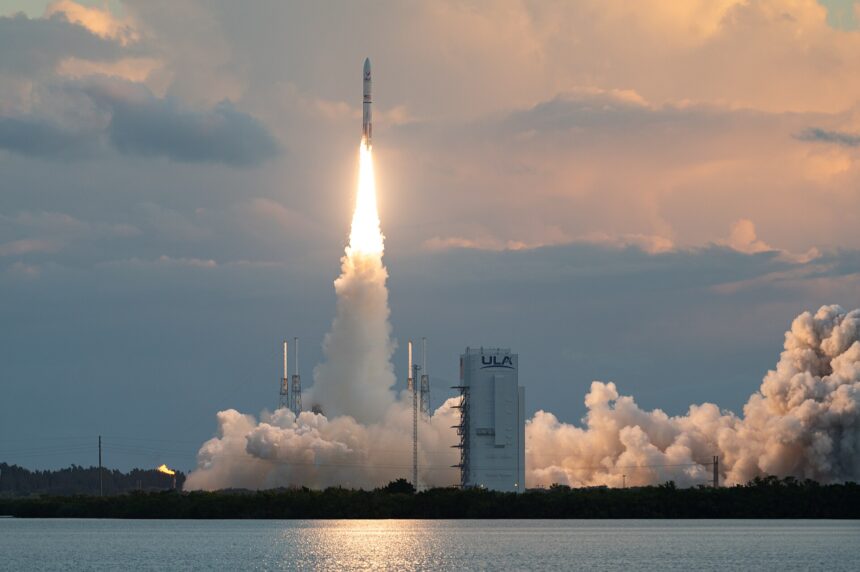
On Sunday, United Launch Alliance’s Vulcan rocket lifted off from Cape Canaveral at 12:40 p.m. Eastern carrying 40 satellites for Amazon Leo, Amazon’s satellite internet network. About 10 minutes later, the mission was over. ULA said the rocket “suffered an anomaly 10 minutes into the flight and failed to deliver the Amazon mission to orbit,” Spaceflight Now reported. It was ULA’s first outright failure since the company was formed in 2006.
Amazon responded on X with a statement that stood by its launch partner:
There is risk with any launch, and that’s especially true for inaugural missions like LV-01. ULA has been a trusted partner for Amazon, and we believe they’ll learn from this mission and deliver on their long-term plans for Vulcan.
Full statement from @ulalaunch below. https://t.co/lS2GEioSak
— Amazon Leo (@AmazonLeo) November 15, 2026
I think the loss of 40 satellites is the smaller problem here. The bigger one is that Amazon’s plan to build a rival to Starlink depends on rockets it does not control, and one of the most important of them is now grounded again.
What went wrong
The cause is not known yet, and early accounts differ. Spaceflight Now said the solid rocket boosters appeared to work normally and that something went wrong during the planned 12-minute firing of the Centaur upper stage. The Next Web, citing Ars Technica and Reuters, reported that the problem appeared to lie in the booster stage instead, with its Blue Origin-built BE-4 engines firing at least 30 seconds past their planned shutdown. Blue Origin is working with ULA on the investigation, according to a source cited by Reuters.
The timing makes it worse. This was billed as Vulcan’s return to flight after solid rocket booster nozzle problems on two earlier missions, in October 2024 and February 2026, according to Space.com. The Space Force had put Vulcan’s national security launches on hold, and the Pentagon had not cleared Vulcan to resume them pending Sunday’s result, The Next Web reported.
Amazon’s launch problem
Amazon had about 400 Leo satellites in orbit before Sunday, launched on Atlas V, Falcon 9 and Ariane 6 rockets, Space.com reported. The full first-generation network is more than 3,200 satellites. To get there, Amazon booked 38 launches on Vulcan, the first of which was Sunday’s, along with 24 on Blue Origin’s New Glenn and 24 on Ariane 6, according to Spaceflight Now.
New Glenn is grounded too. It suffered an on-pad explosion in May caused by an oxygen valve problem in one of its BE-4 engines, Spaceflight Now reported, and The Next Web said Blue Origin has already delayed its return to January. Amazon already missed a July deadline to have half its network in service; the FCC gave it more time while stripping some spectrum priority, The Next Web reported, and it has until July 2029 to deploy the full first generation.
My take: Amazon bet that buying rides on several new heavy rockets would spread its risk. Instead, two of the three main ones now share an engine supplier under scrutiny, and both are on the ground at the same time. SpaceX, which builds its own rockets and its own satellites, does not have that problem.
The case for staying the course
There is a strong argument that this is a setback, not a crisis. ULA went two decades without losing a mission, a record few launch companies can match, and Amazon called it “a trusted partner” that it expects to learn from the failure. The next Amazon launch, on an Ariane 6 with 36 satellites, was set for November 23 at the earliest, according to GeekWire via The Next Web, so deployment does not stop. And NASA Administrator Jared Isaacman publicly offered help, writing that “Artemis, Moon Base, and the nation need ULA,” per Spaceflight Now.
There is also a national interest in Vulcan succeeding. Ars Technica estimates Vulcan was set to carry about half of national security launches over the next few years, The Next Web reported. Without it, the U.S. government would lean even harder on SpaceX.
That is exactly the counterpoint, though. A launch market where one company is the only fully reliable heavy-lift option is a risk for everyone who is not that company, from Amazon to the Pentagon.
What to watch
I’d watch three things. First, whether the investigation points at the BE-4 engines, which would affect New Glenn as well as Vulcan. Second, whether Amazon shifts more launches to Falcon 9 or Ariane 6 to keep its schedule. Third, how long the Space Force waits before clearing Vulcan again. Amazon can afford to lose 40 satellites. What it cannot afford is a year without enough rockets.
Related reading: SpaceX Caught Starship After 14 Orbits. · Starlink Slowed Ukraine’s Drone Links for Days.